iPad
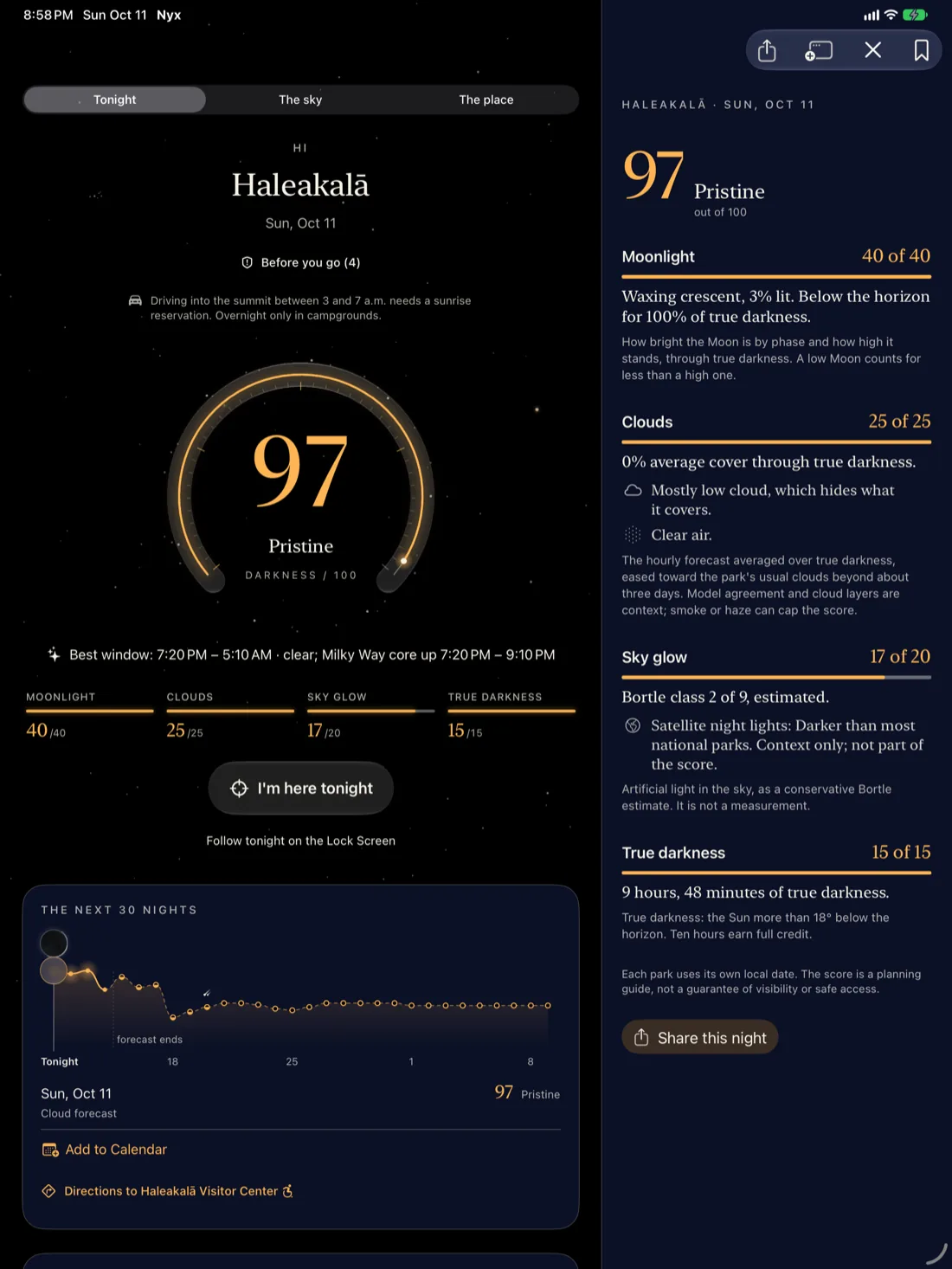
The score beside its full breakdown in wide windows, any orientation, a park in its own window, and parks or nights you can drag onto Plan or the journal.
The darkest nights, wherever you are
Nyx weighs the moonlight, the clouds, the sky glow and the hours of true darkness for each place and night, and turns them into one score from 0 to 100: for the 63 US national parks, about 3,400 national parks and certified dark-sky places in 172 countries, and any spot you save. It shows its reasons, puts US park closures beside the number, and says what it cannot know.
The darkness score
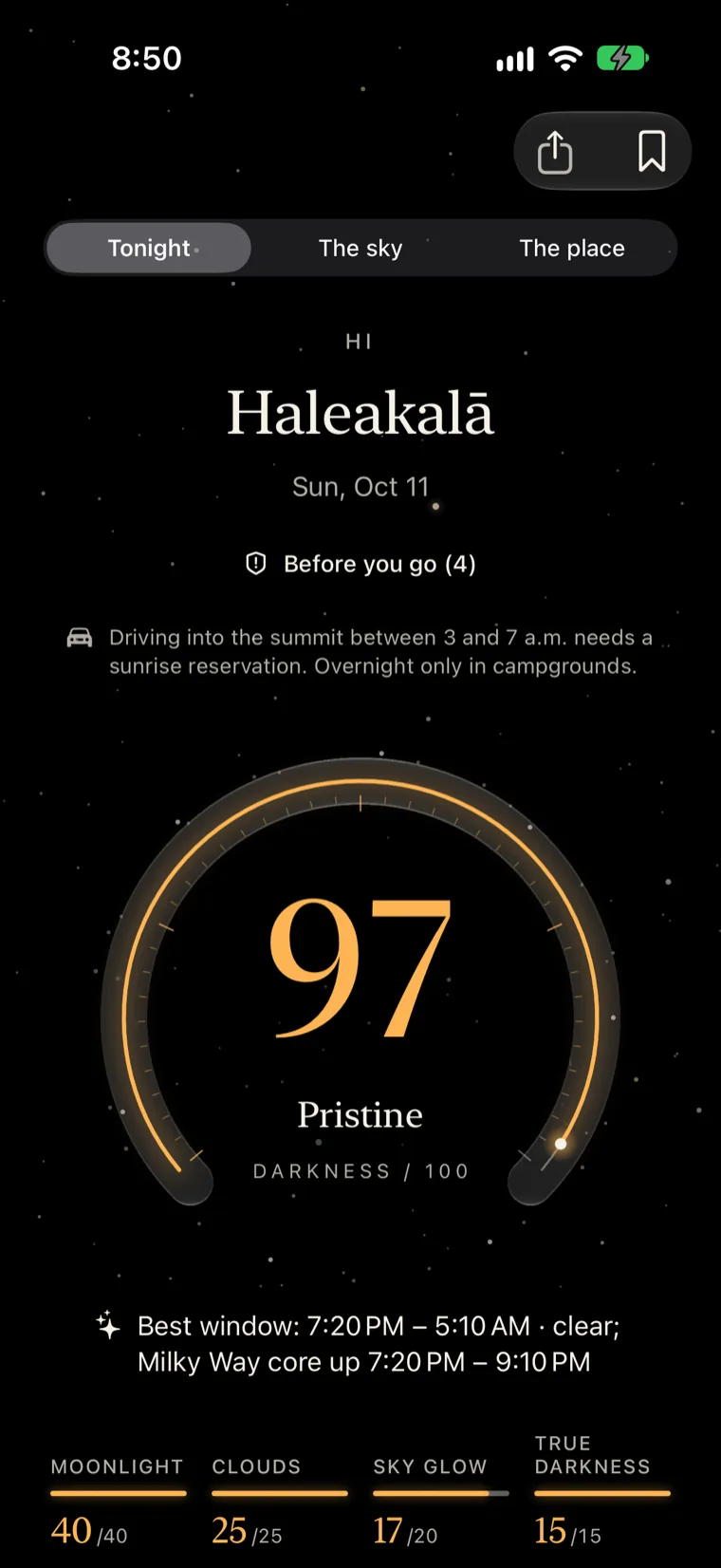
Four things decide whether you will see the Milky Way. Nyx adds them up for each place and night, then lets the weakest one hold the total down, because one problem is enough to spoil a night.
How much moonlight reaches the sky through the hours of true darkness, by the Moon's phase and height.
Averaged over the hours of true darkness only. At the US national parks, three weather models are compared for the coming week.
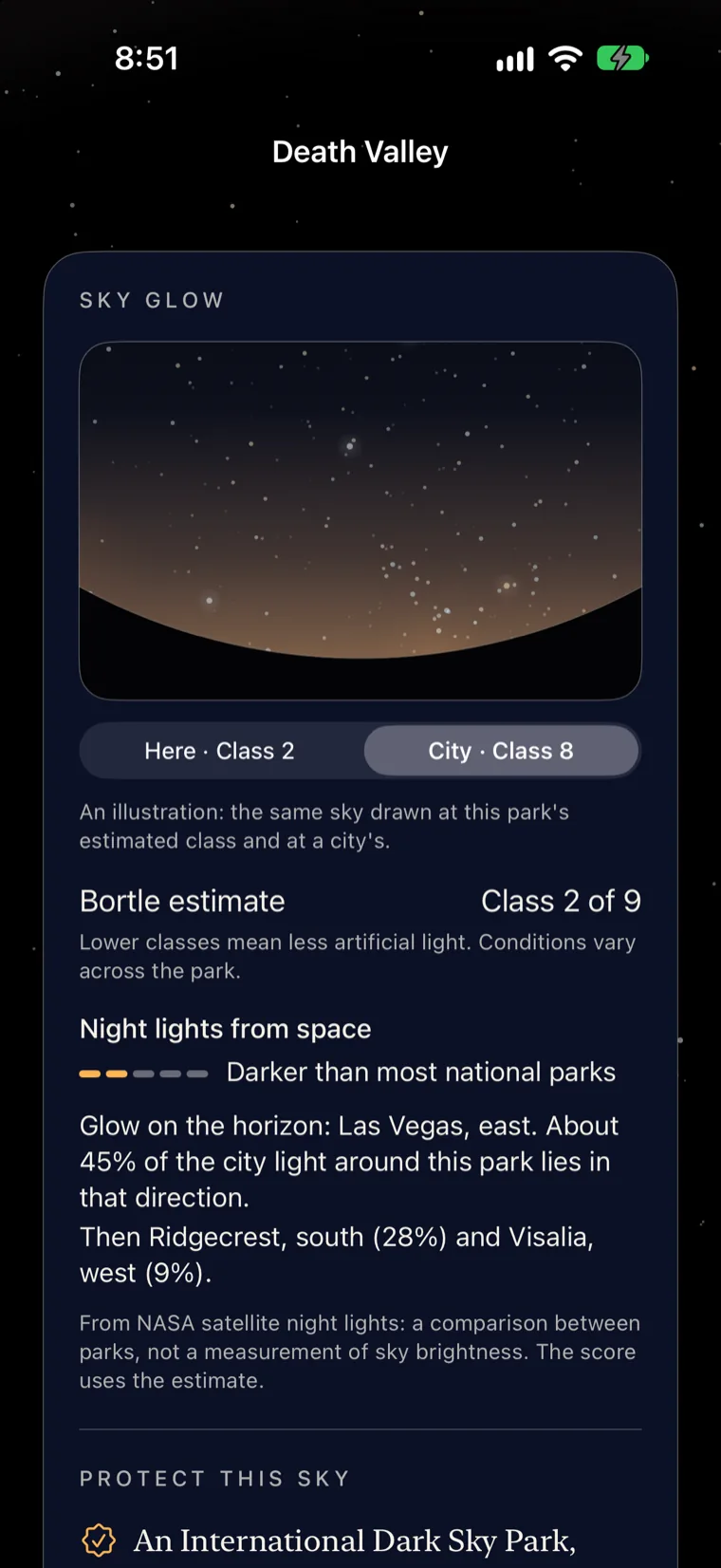
The park's estimated Bortle class, with satellite night lights to show where the glow comes from.
Hours with the Sun 18° below the horizon. In an Alaskan summer there are none, and Nyx says so.
The weakest part can cap the rest. Heavy cloud, a bright sky, wildfire smoke or a short night holds the score down, and Nyx names the cap under the number: "Clouds limit tonight to 55." An overcast night never reads as good.
Score bands:
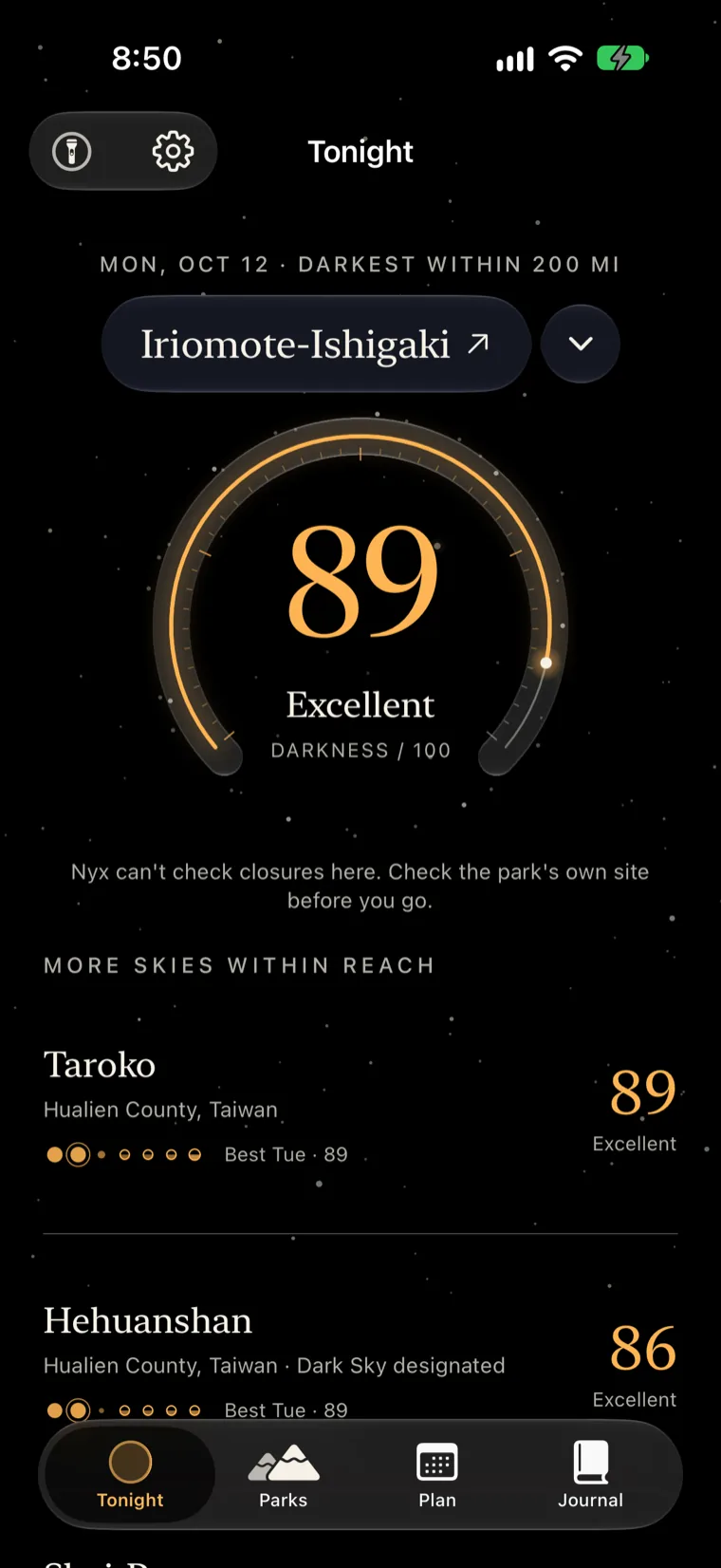
Tonight
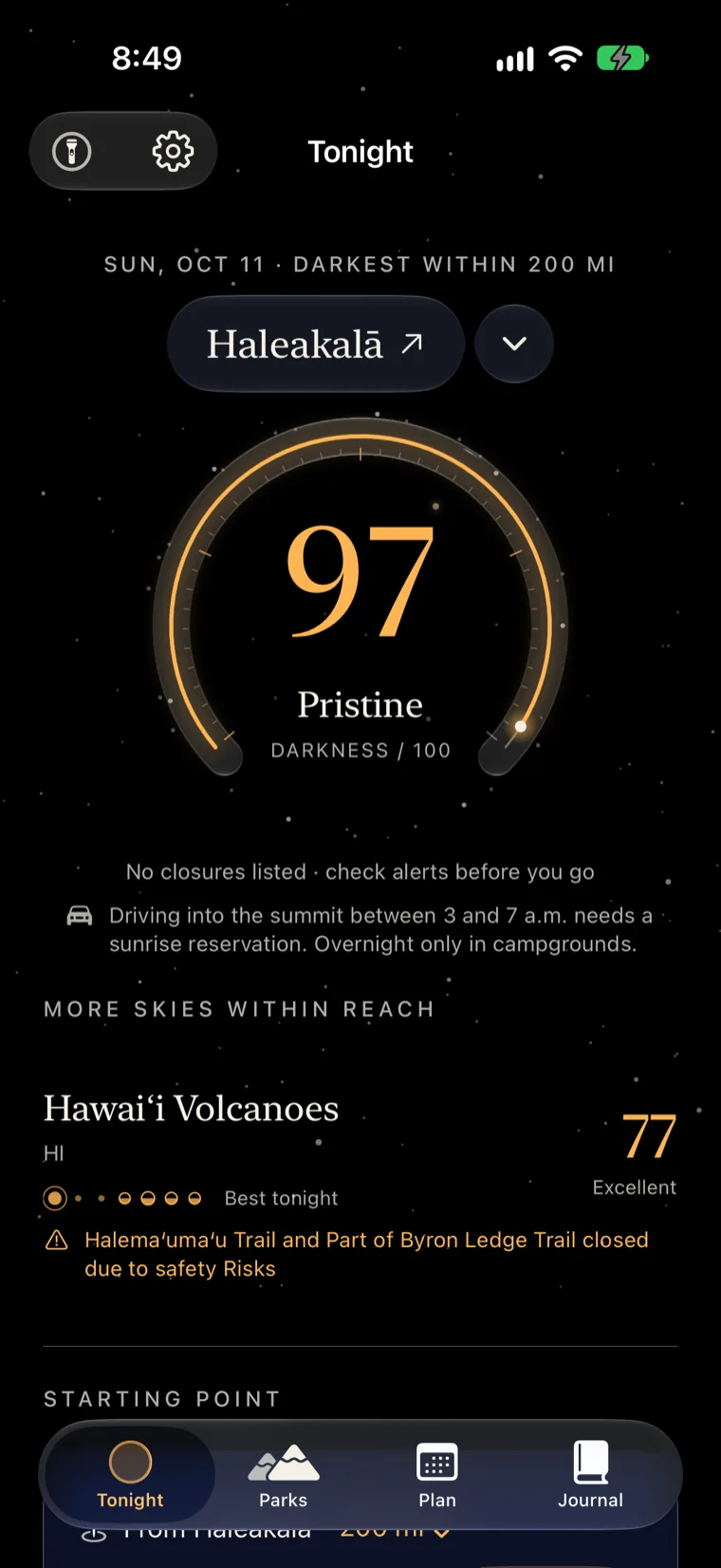
Start from where you are, from any of more than 31,500 towns and cities, from a park, or from a spot you saved. Nyx shows the best-scoring places around it tonight, with the reasons on the same screen.
The park, in three chapters
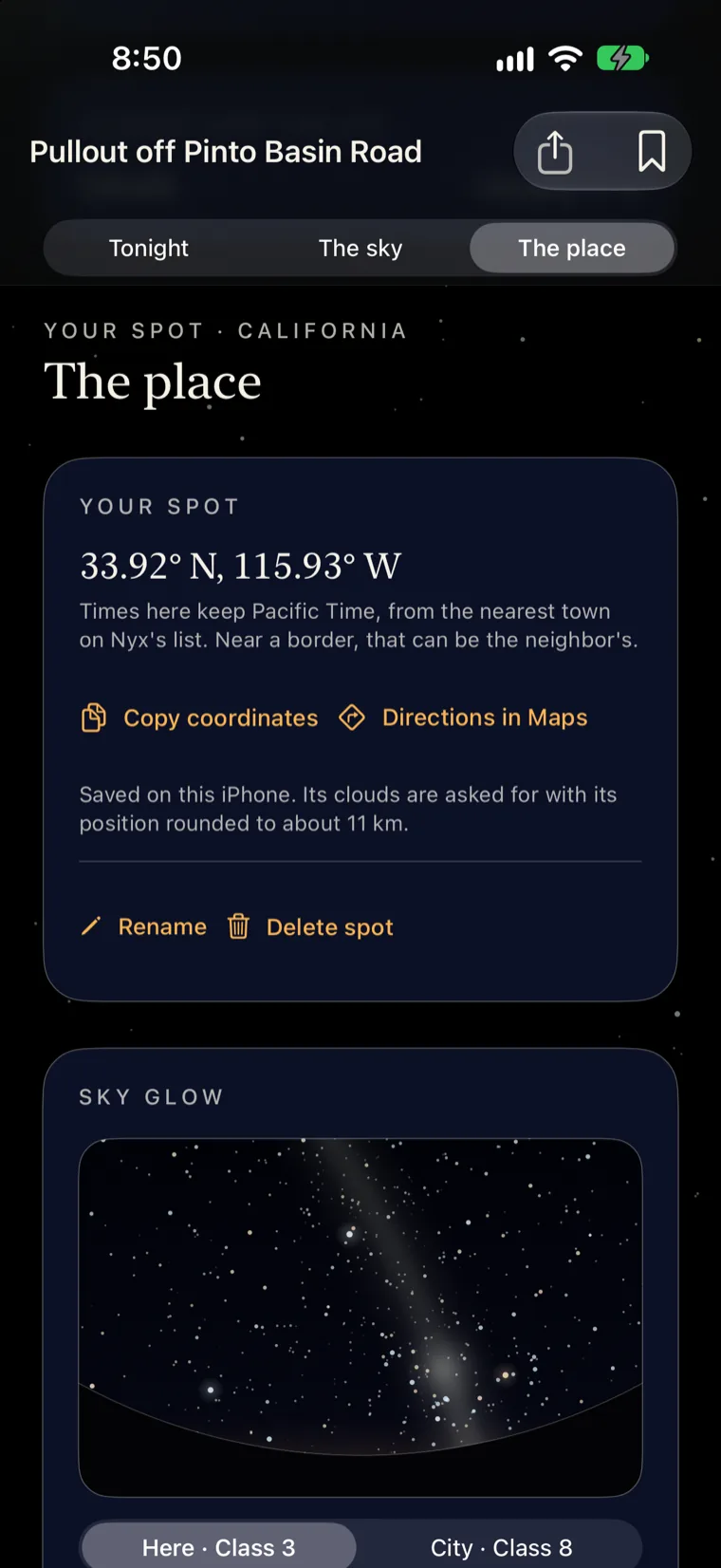
Each park's page reads in three chapters: tonight's score and its best window, the sky and what is in it, and the place itself, with viewing spots, sky glow and where to stay.
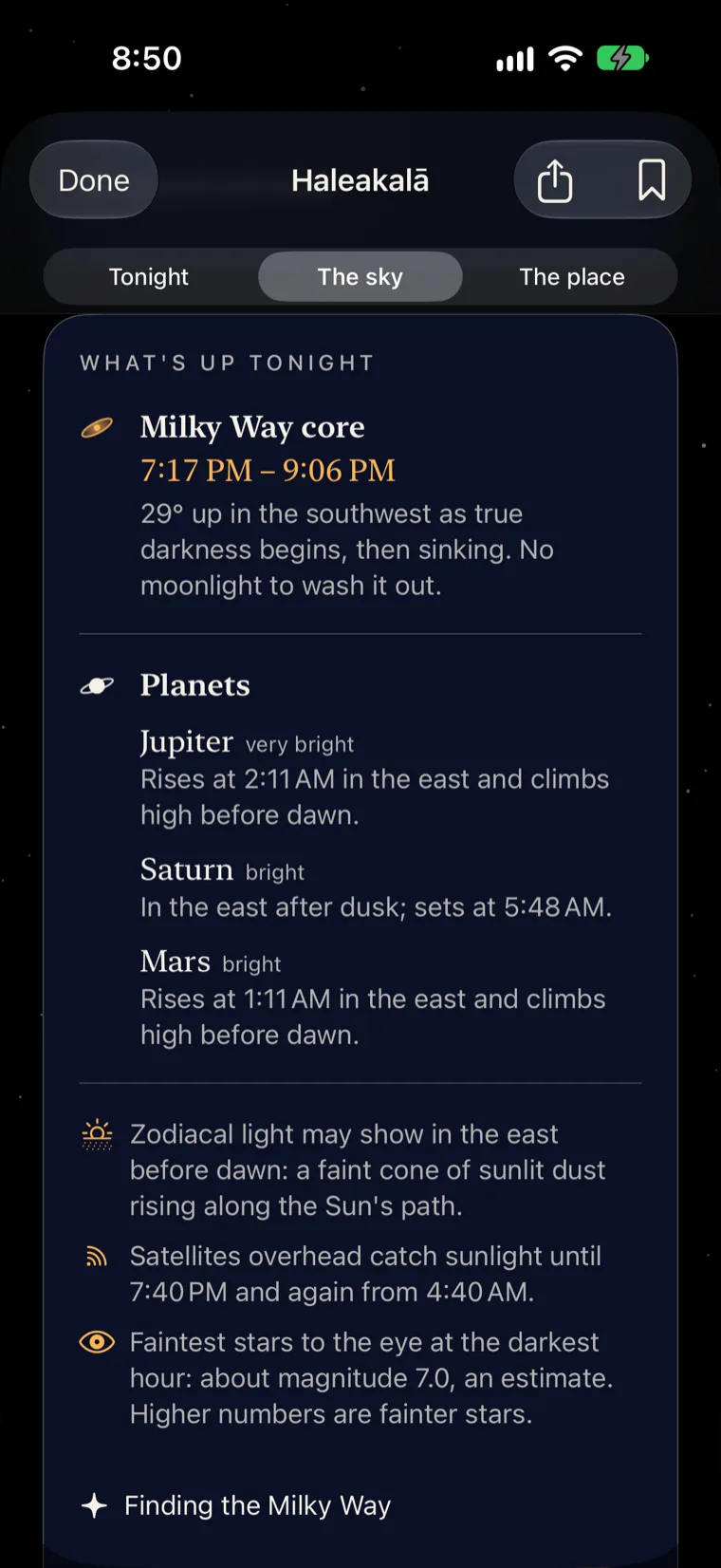
What's up tonight
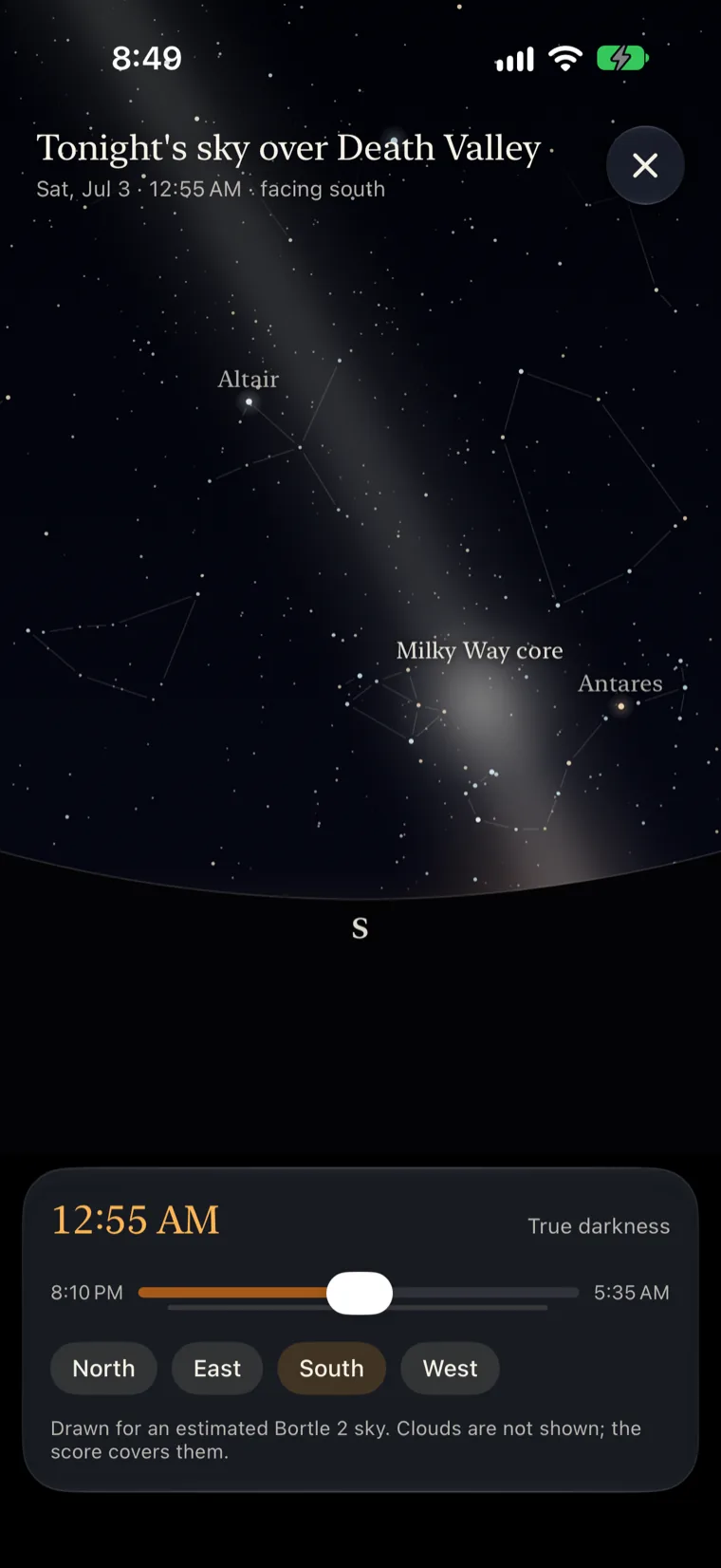
The galactic core timed for the park you chose, the planets with where and when they rise, meteor showers with an honest rate range, zodiacal light, satellites, and lunar eclipses the park can actually see.
Plan
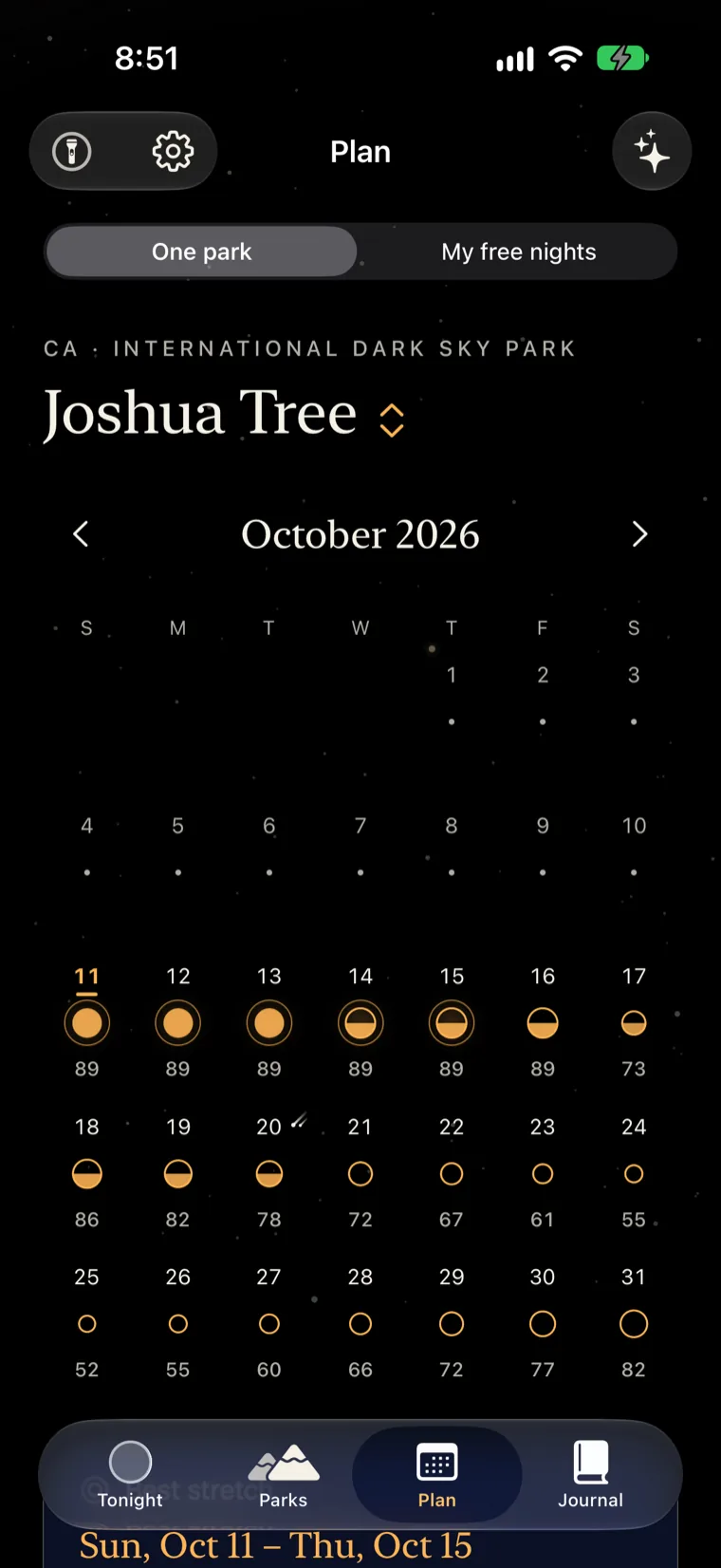
A month for one park, each night a small sky sized by its score, with the best five nights in a row ringed. Or tell Nyx which nights you are free, and it suggests a park for each.
A forecast is reliable for a few days. After that Nyx leans on each park's usual clouds, so every night shows which it is:
Every park tonight
The Parks tab draws all 63 US national parks by tonight's score, from Acadia to American Samoa, with closures marked. Around the world, places are grouped by country, with a world map. Tap a place to open it, or switch to the list.
Field mode
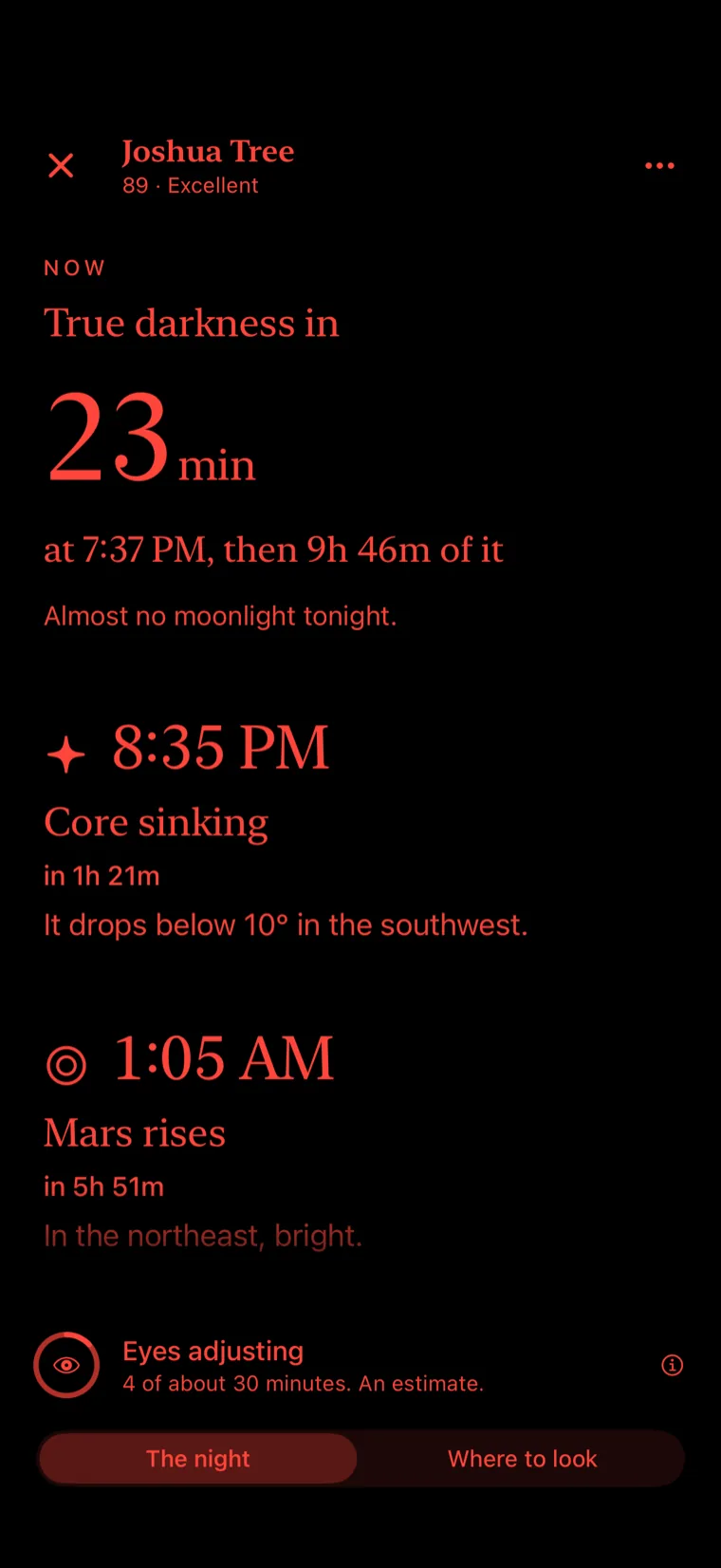
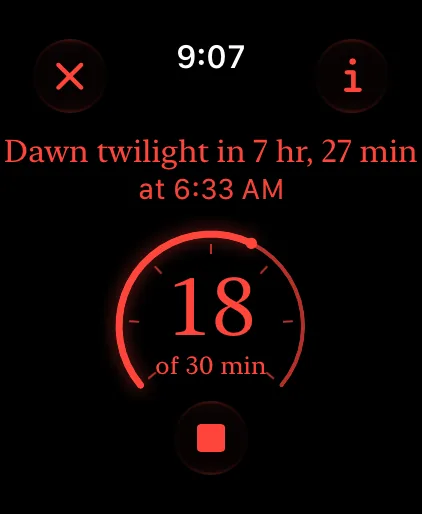
Your eyes need twenty to thirty minutes to adapt to the dark, and one glance at a bright screen undoes much of it. Field mode dims everything to deep red, counts down to true darkness and turns the real sky to wherever you point the phone, with no camera.
Journal
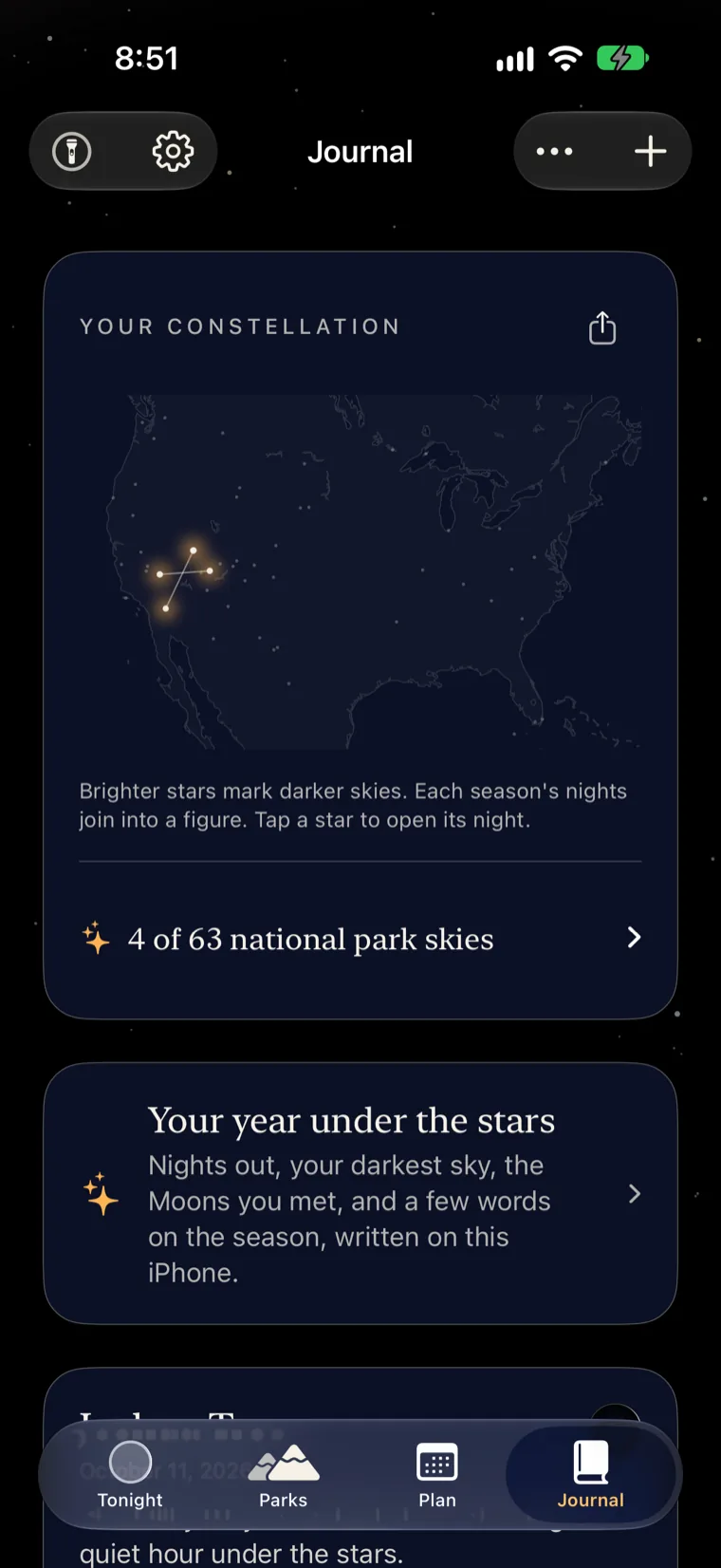
A private journal turns each night out into a star in your own constellation, and gathers your year under the stars. Add a night by voice with Siri, describe your photos, and export the journal as a file you keep.
For more people
Every custom control in Nyx speaks a summary of its data. "Listen to tonight" plays the shape of the night as tones, with a transcript, and "Feel tonight" plays it as touch. Audio graphs let VoiceOver users hear a month of darkness.
New in 2.2
Nyx 2.2 is a free update. It fills both displays of iPhone Duo and meets the fold, turns to landscape on every iPhone, starts from the towns at the park gates, and has a new icon.
Open or closed
Closed, the tabs and buttons sit in the side bar. Open, Tonight, a park and the Journal spread across two columns, and Parks shows the list beside the park. Half open like a book, the columns meet at the fold.
Landscape on iPhone
Nyx turns with your iPhone. Field mode sets the night beside Where to look, and the keyboard stays clear of what you are writing.
Start at the gate
Starting point finds 85 gateway towns, such as Moab, Springdale, Estes Park and West Yellowstone, so you can plan from where you will sleep.
A new icon
Drawn for Liquid Glass: the score dial at 90, with a single star. On Apple Vision Pro, night vision now uses the iPhone's red, and a line under the score says that smoke and haze are not counted there.
New in 2.0
Nyx 2.0 brings together everything since 1.1, and now looks for the darkest nights around the world. The 63 US national parks stay at its heart, checked by hand as before.
Around the world
About 3,400 national parks and certified dark-sky places in 172 countries, each scored night by night. Sky brightness and usual clouds are labeled as estimates, and a place abroad says plainly that Nyx cannot check its closures.
Start anywhere
Any of more than 31,500 towns and cities as your starting point, or a spot of your own: where you stand, a pair of coordinates or a town. Spots are scored and followed like parks.
Private by region
Forecasts for places abroad are asked for by whole regions, about the size of a country. A spot you save is sent only rounded to about 11 km (7 miles), behind its own switch.
A closer look at the sky
The Moon in relief from NASA's elevation data, tonight's sky with the brightest stars named, and the forecast models' range on the dial when they disagree.
In five languages
English, Spanish, German, French and Japanese. The translations are drafts; native speakers will review each one, and their corrections follow in updates.
On every device
The score beside its full breakdown in wide windows, any orientation, a park in its own window, and parks or nights you can drag onto Plan or the journal.
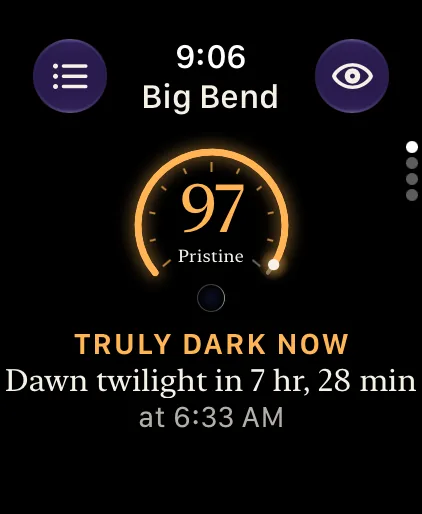
Tonight's score on your wrist, the Digital Crown to look a week ahead, the forecast models' range when they differ, a dark-adaptation clock that taps when your eyes are ready, and a face that turns red at dusk.
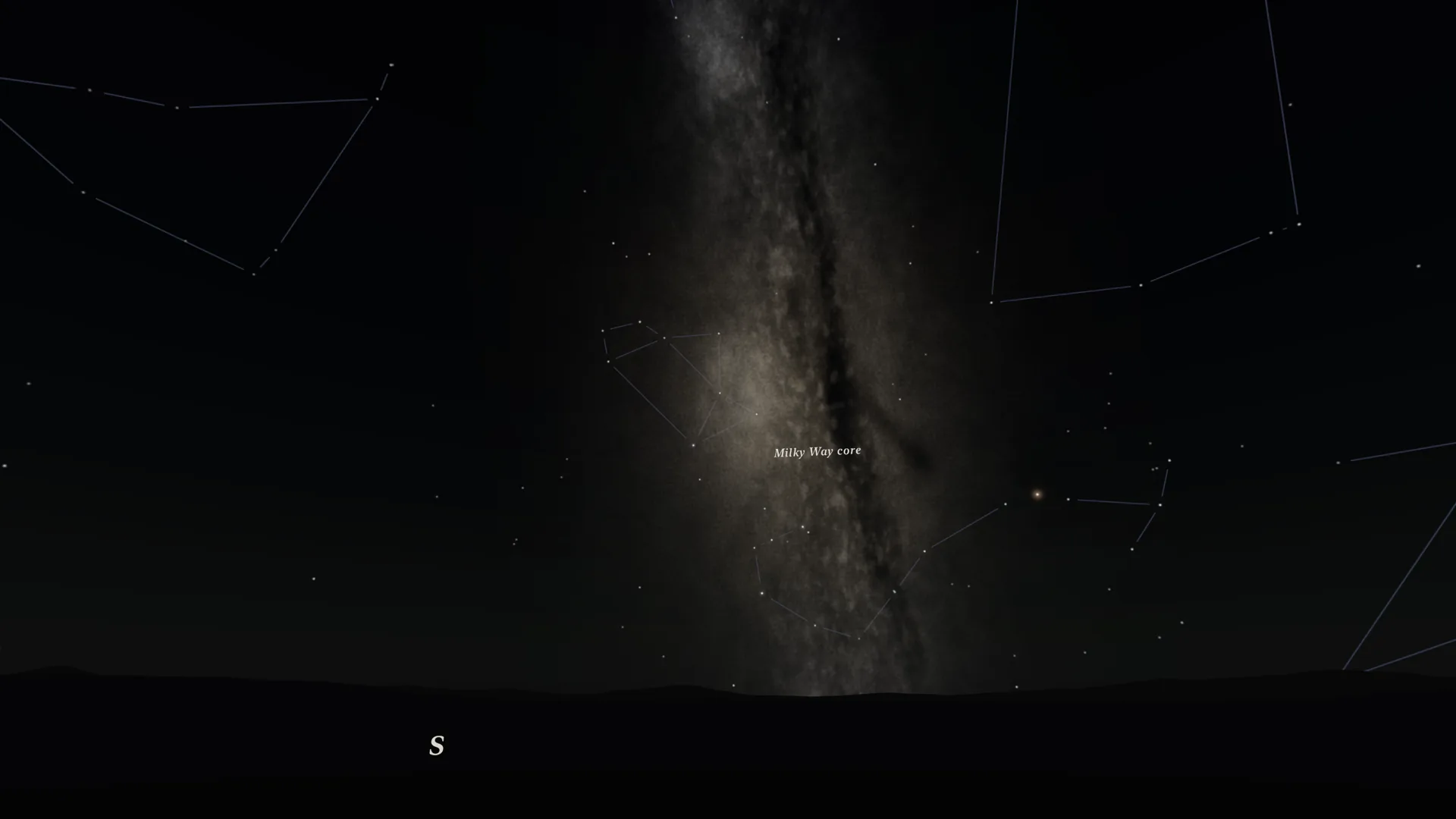
Stand under a US national park's computed sky on the night you choose, with the forecast's clouds. Tap a star for its name, turn the night by hand, and set the Moon, lit at its true phase, on your table.
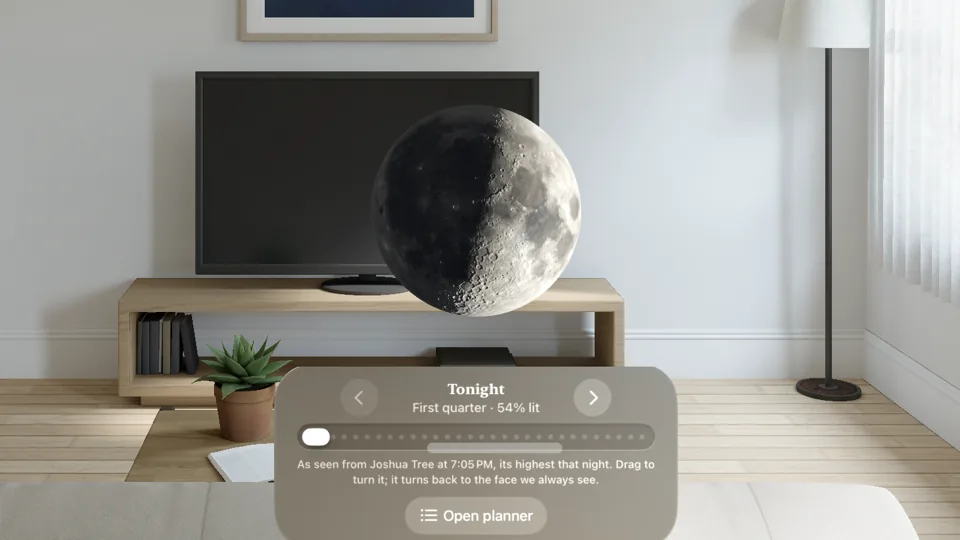
On Apple Vision Pro, the Moon in NASA's color and relief, lit from the Sun's true direction for the night you pick, so its shadow line crosses craters as the phase turns.
Honest by design
A planning app is only useful if you can trust it, so Nyx draws its uncertainty instead of hiding it.
Models side by side
At the US national parks, three weather models are compared for the next week. When they disagree, Nyx draws the range and says so.
Usual clouds, labelled
Beyond about three days, the forecast eases toward each park's usual clouds for the month, from ten years of climate records, and those nights are marked.
Estimates called estimates
Bortle classes, sky glow and meteor rates carry the word. Moonrise agrees with the U.S. Naval Observatory to within minutes.
Access first
A high score never means a road is open. At the US national parks, closures sit beside the number, and if alerts can't load, Nyx says so and links to the park's current conditions. Elsewhere it says it cannot check closures.
Privacy
No account, no ads, no analytics, no tracking. The astronomy runs on your device, so the Moon, twilight and the Milky Way work offline. Your journal never leaves your device.
This website is the same: no cookies, no scripts, no analytics.
App Store privacy label
Data Not Collected
Nyx asks three public services for data, and each has its own switch in Settings:
api.open-meteo.comCloud forecasts: for the 63 US parks by their public coordinates, with the cloud layers above Haleakalā's summit, for places abroad by whole regions, and for spots you save rounded to about 11 km (7 miles). Never where you are, unless you save it as a spotair-quality-api.open-meteo.comSmoke and haze forecasts for the 63 US parksdeveloper.nps.govPark alerts and campgrounds for all 63 US parks, and ranger night-sky programs for the park you open
Free, with no subscriptions or in-app purchases. For iPhone and iPad with iOS 26 or later, Apple Watch, and Apple Vision Pro.
Every number in the screens comes from the app's own engine and real forecasts on October 11, 2026. The sky screen shows a chosen summer night; the journal and the saved spot use samples.