 Nyx
NyxPress kit
Plan a darker night.
Nyx is a free app that tells you where and when the sky will be darkest: at the 63 US national parks, at national parks and dark-sky places around the world, and at any spot you save.
The story
National parks recorded more than 323 million recreation visits in 20251, and night is part of why people come: in a survey at Acadia, nearly 90 percent of visitors agreed that viewing the night sky was important to them2. Yet a trip to see the Milky Way still fails for reasons no single app joined together: a bright Moon, a cloud deck, the glow of a distant city, or a closed road. Nyx asks one question, where should I go and on which night, and answers it with a darkness score for each park and night, explained in four plain parts. Version 2.0 takes the same question around the world, with the US national parks still at its heart. It runs its astronomy on the device, says what it does not know, and collects nothing.
Fact sheet
- Name
- Nyx: Dark Sky Planner (the Home Screen name is Nyx)
- Developer
- Hardik Pakhale, an independent developer
- Version
- 2.2, described on this page. Nyx has been on the App Store since October 7, 2026. 2.2 follows 2.1 as a free update: it fills both displays of iPhone Duo and meets the fold, turns to landscape on iPhone, finds 85 gateway towns as starting points, and has a new icon drawn for Liquid Glass.
- New in 2.0
- Places around the world, starting points in any of more than 31,500 towns and cities, and spots of your own; a score that clouds and city light can cap; a Plan tab and followed nights on the Lock Screen; the Moon in relief from NASA's LOLA elevation data; Tonight's sky with the brightest stars named; Assistive Access; German, French and Japanese.
- App Store
- apps.apple.com/app/id6818817800. Nyx is free on the App Store for iPhone and iPad, with the Apple Watch app, and for Apple Vision Pro. 2.2 follows 2.1 shortly.
- Price
- Free. No subscriptions, advertising or in-app purchases.
- Platforms
- iPhone and iPad (iOS and iPadOS 26.0 and later), Apple Watch (watchOS 26 and later, with Nyx on iPhone) and Apple Vision Pro (visionOS 26 and later)
- Availability
- Every App Store storefront except mainland China and the EU.
- Languages
- English, Spanish, German, French and Japanese in the app. The four translations are drafts pending review by native speakers. The App Store page is in English.
- Category
- Travel; Weather
- Privacy
- App Store privacy label: Data Not Collected. No account, analytics or tracking. Location, journal and photos stay on the device.
- Coverage
- The 63 US national parks, checked by hand, with 85 named viewing spots; 3,359 national parks and certified dark-sky places in 172 countries, from Wikidata, more than 31,500 towns and cities to start from; any spot you save. Times are local to each place.
- Website
- get-nyx.com · Case study
- Privacy policy
- get-nyx.com/privacy
- Support
- get-nyx.com/support
- Press contact
- harry.pakhale98@gmail.com
What it does
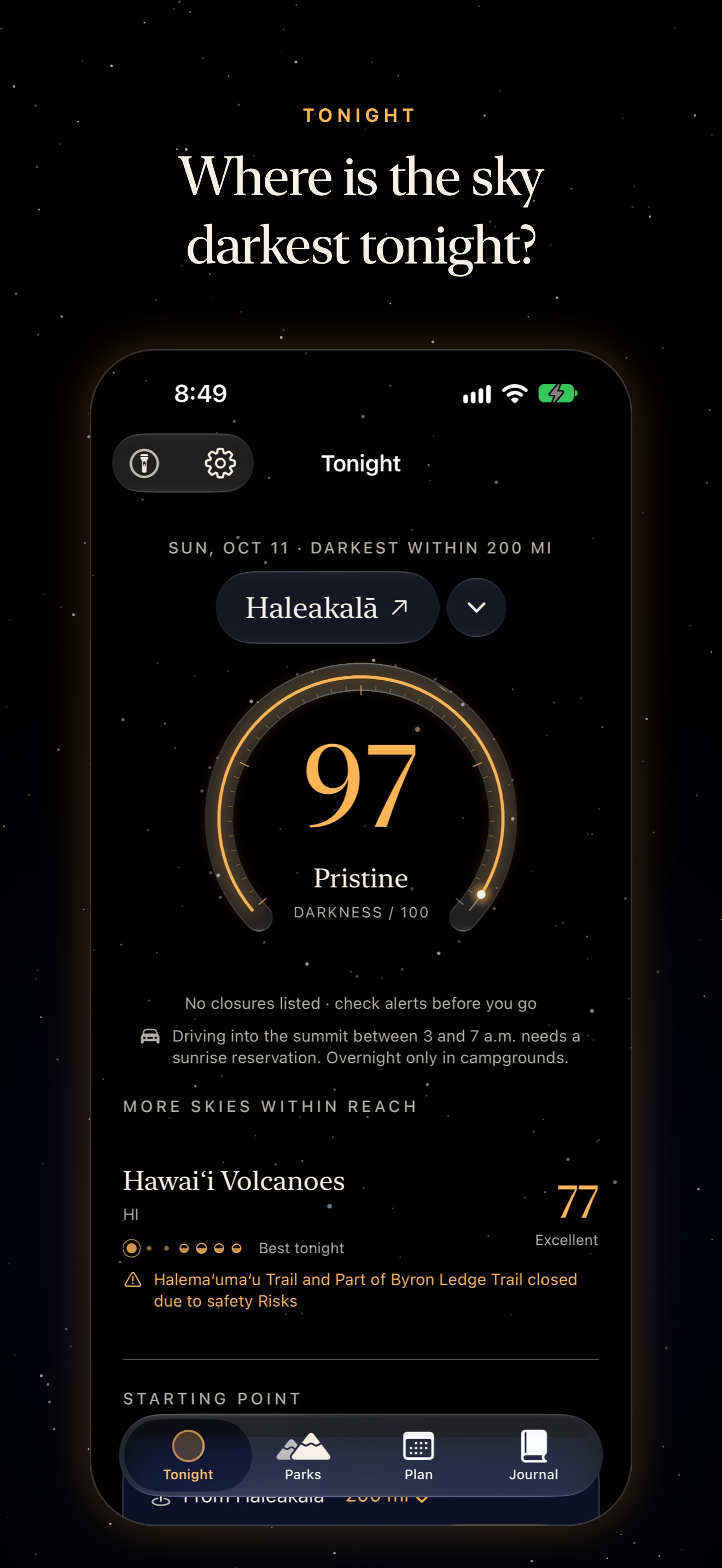
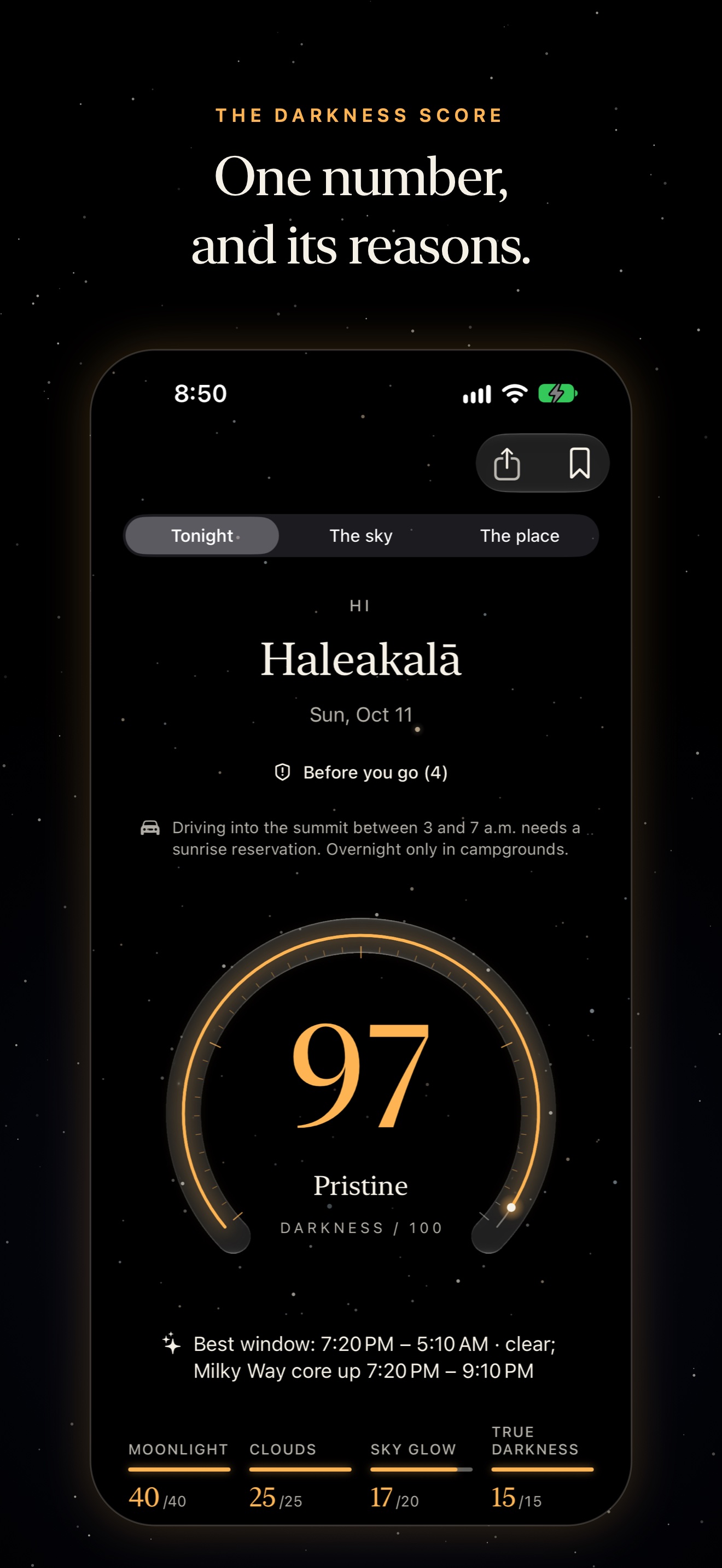
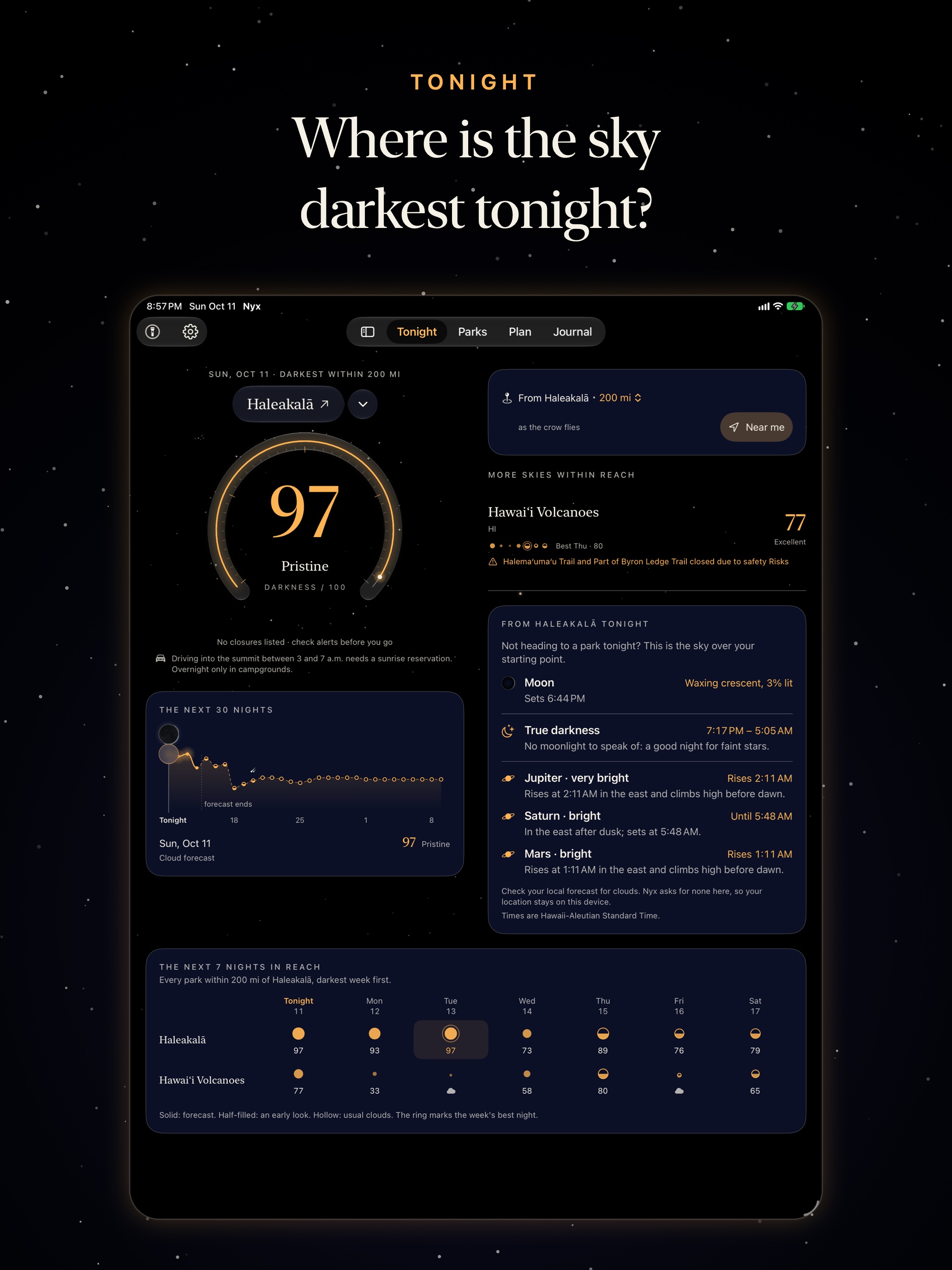
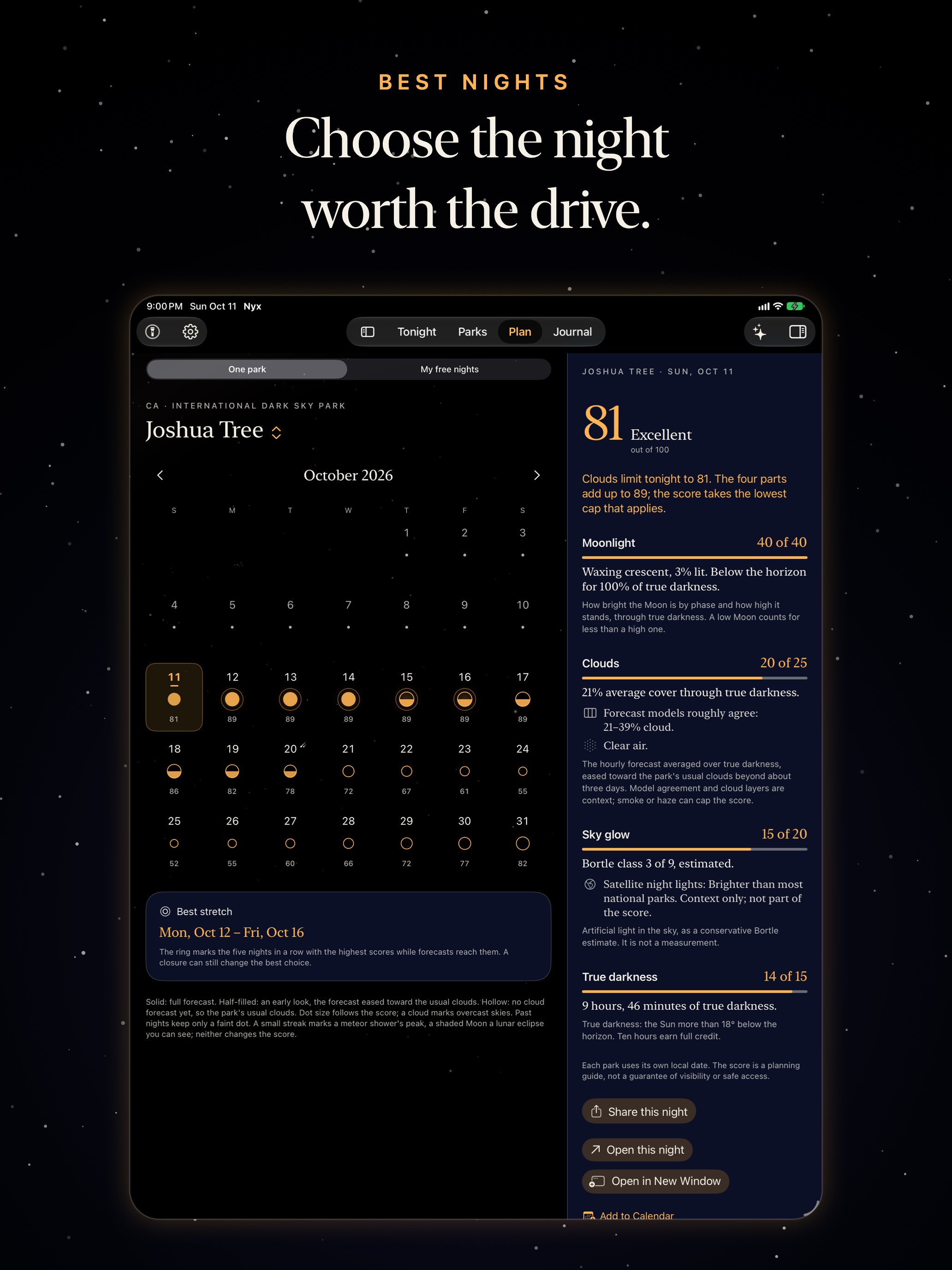
- One darkness score per place per night, from 0 to 100: moonlight (40), clouds (25), sky glow (20) and true darkness (15), with the weakest one allowed to cap the rest, so an overcast night can never read as good.
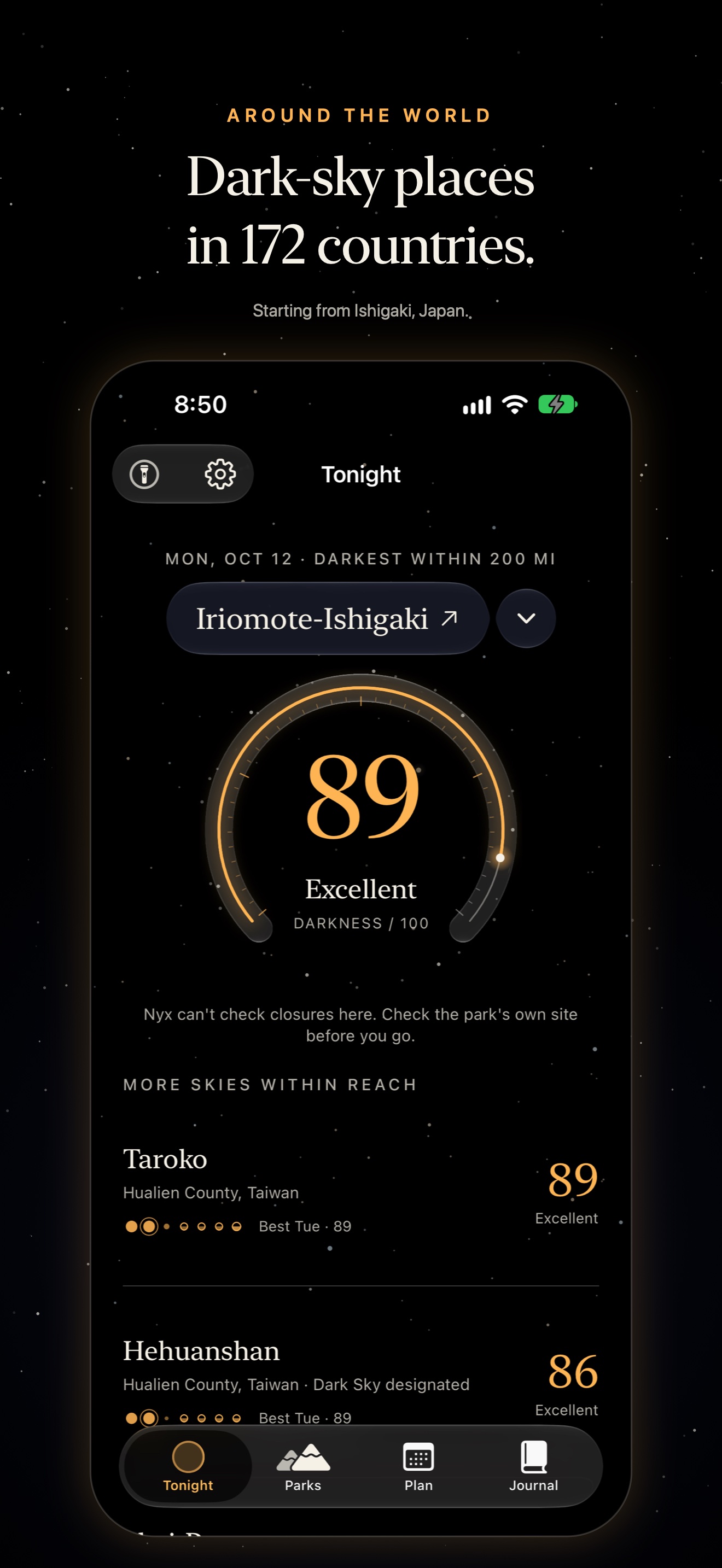
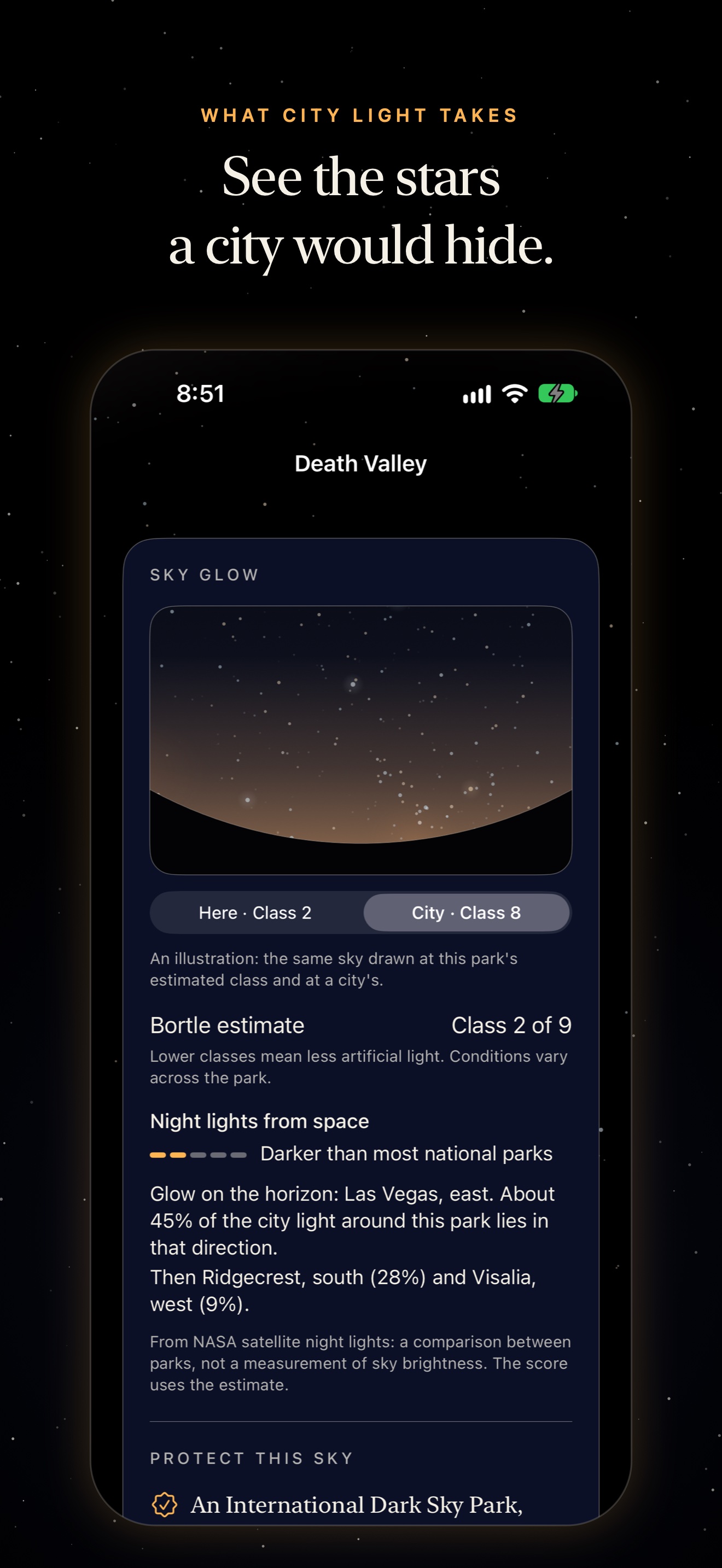
- Around the world. National parks and certified dark-sky places in 172 countries, with sky brightness from NASA's satellite night lights and usual clouds from ten years of weather records, both labeled as estimates. A place abroad says plainly that Nyx cannot check its closures, and links its official site. Forecasts for places abroad are asked for by whole regions, and a saved spot is sent only rounded to about 11 km (7 miles).
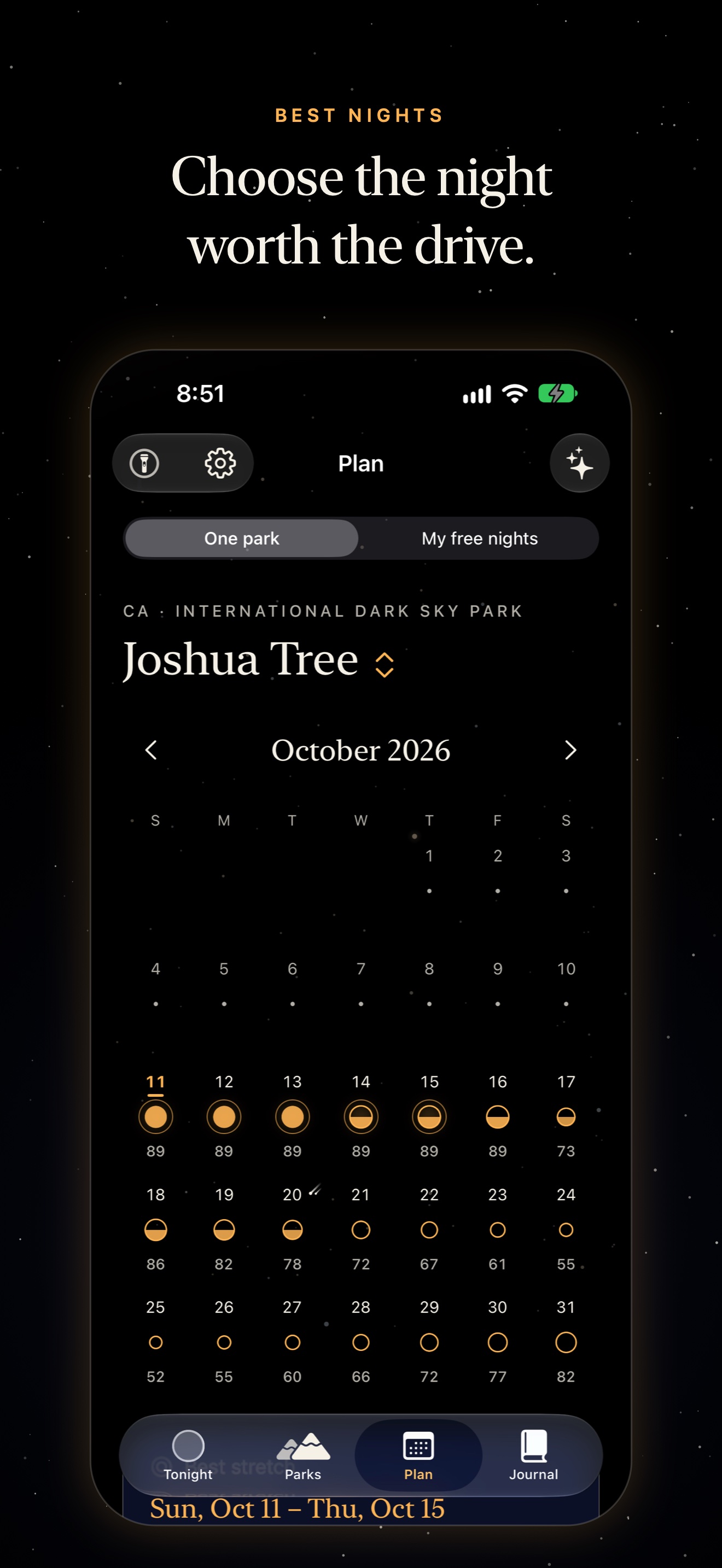
- Where and when. Tonight's darkest places within a straight-line radius of where you are, a town or city, a park or a spot you saved; Plan, with a month for one park and its best stretch of nights, a thirty-night time river whose Moon changes shape as you scrub, and a planner that suggests a park for each of your free nights; and a map of all 63 US parks by tonight's score, with a world map beside it.
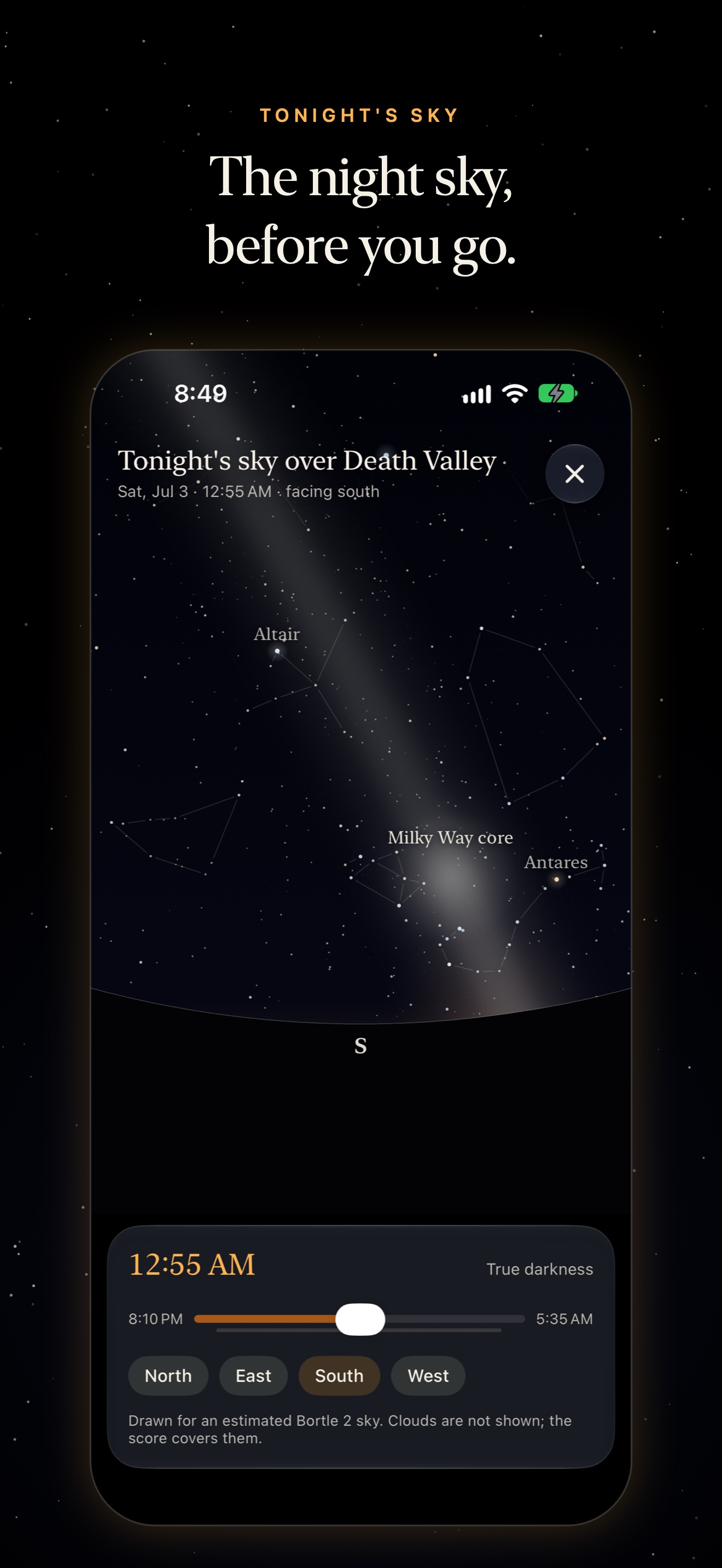
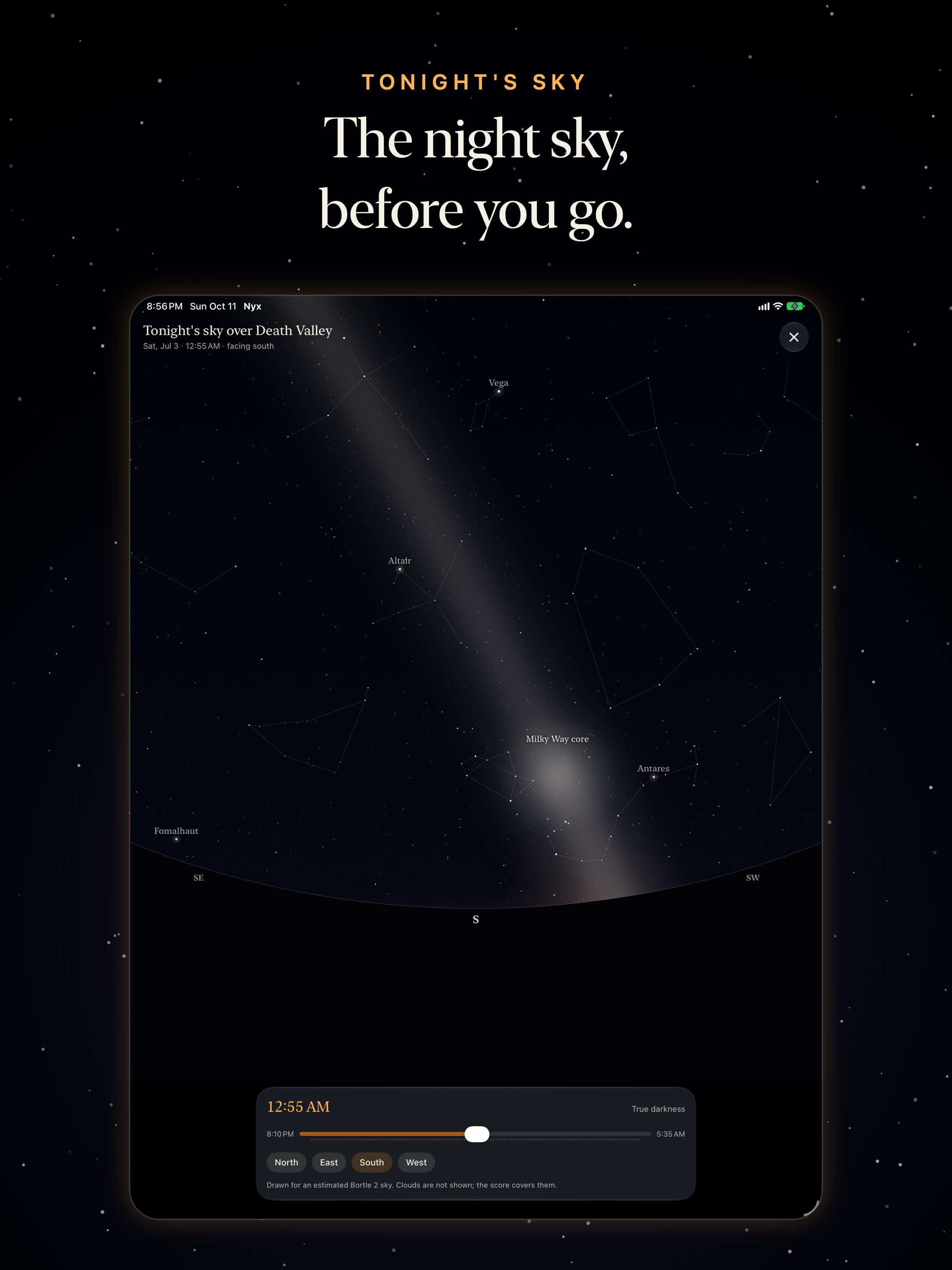
- The park, in three chapters. Tonight, The sky and The place: the score and its best clear window, a full-screen view of tonight's sky with the brightest stars named, viewing spots, sky glow and where to stay, with campground links only to Recreation.gov or nps.gov.
- Closures beside the score. At the US national parks, National Park Service alerts sit next to the number, because a dark sky is no use behind a closed road.
- An honest forecast. At the US national parks, three weather models compared, with their range drawn on the dial when they disagree; cloud layers, dew, cold and wind through true darkness; wildfire smoke that can cap the score. Beyond about three days the forecast is eased toward each place's usual clouds for the month, and those nights say so.
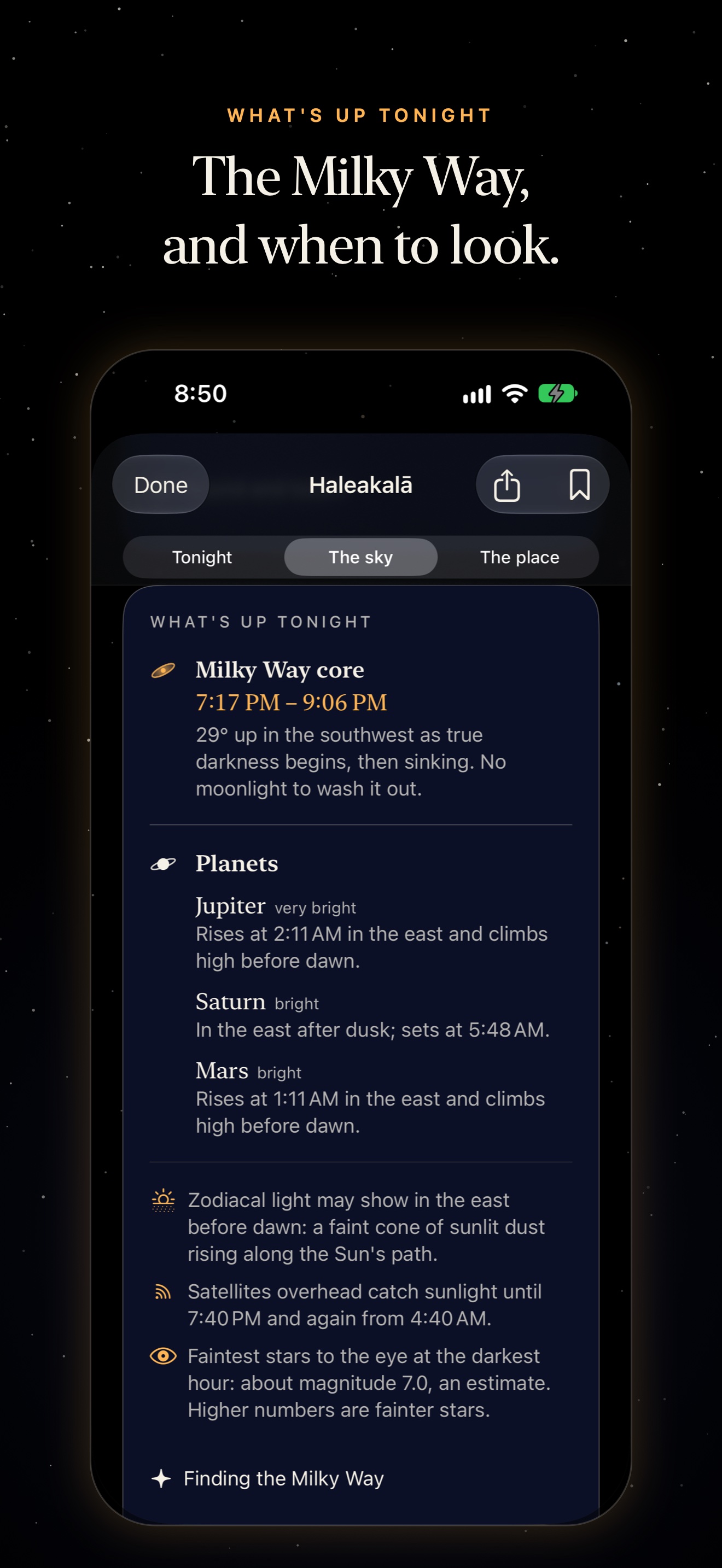
- What's up tonight. The Milky Way core timed for each park, planets, meteor showers with a rate range, and lunar eclipses the park can see.
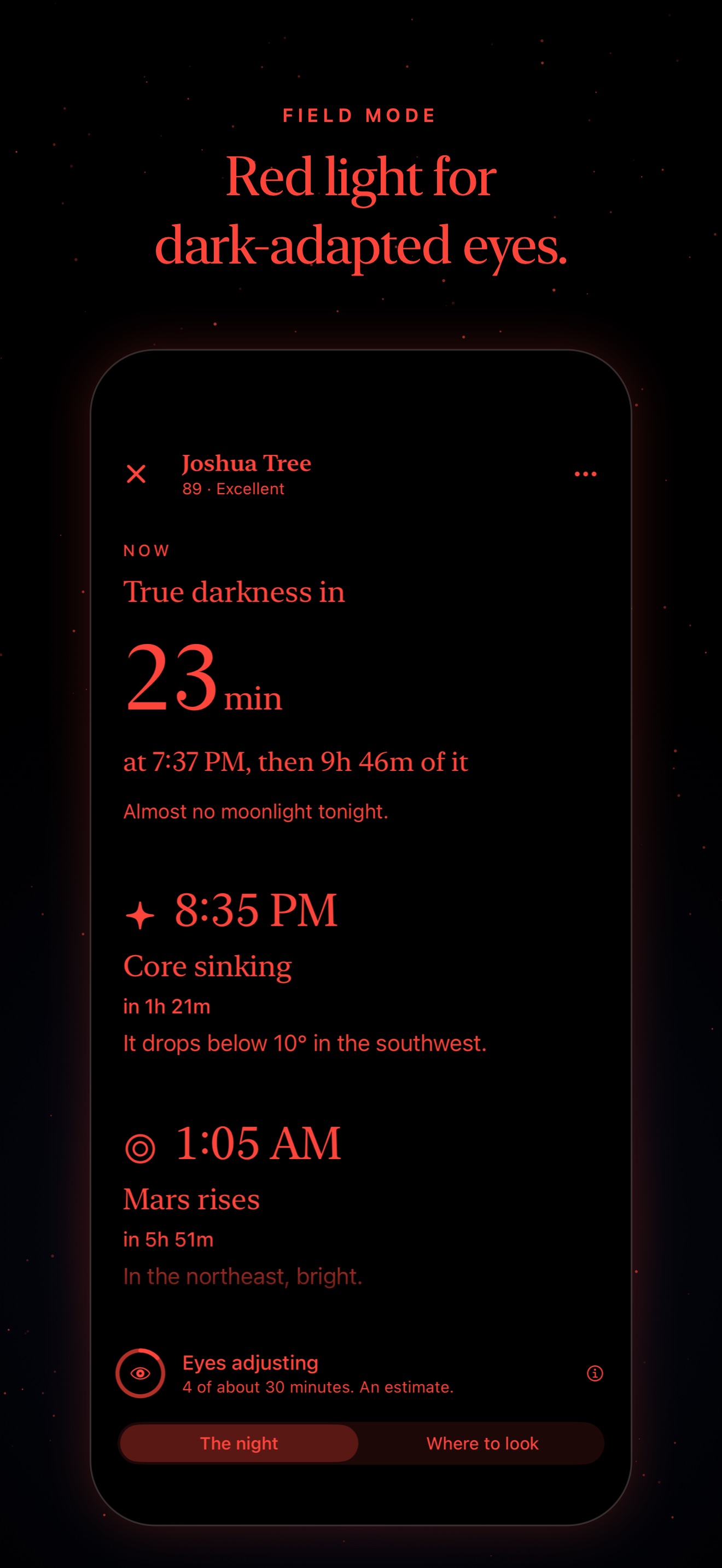
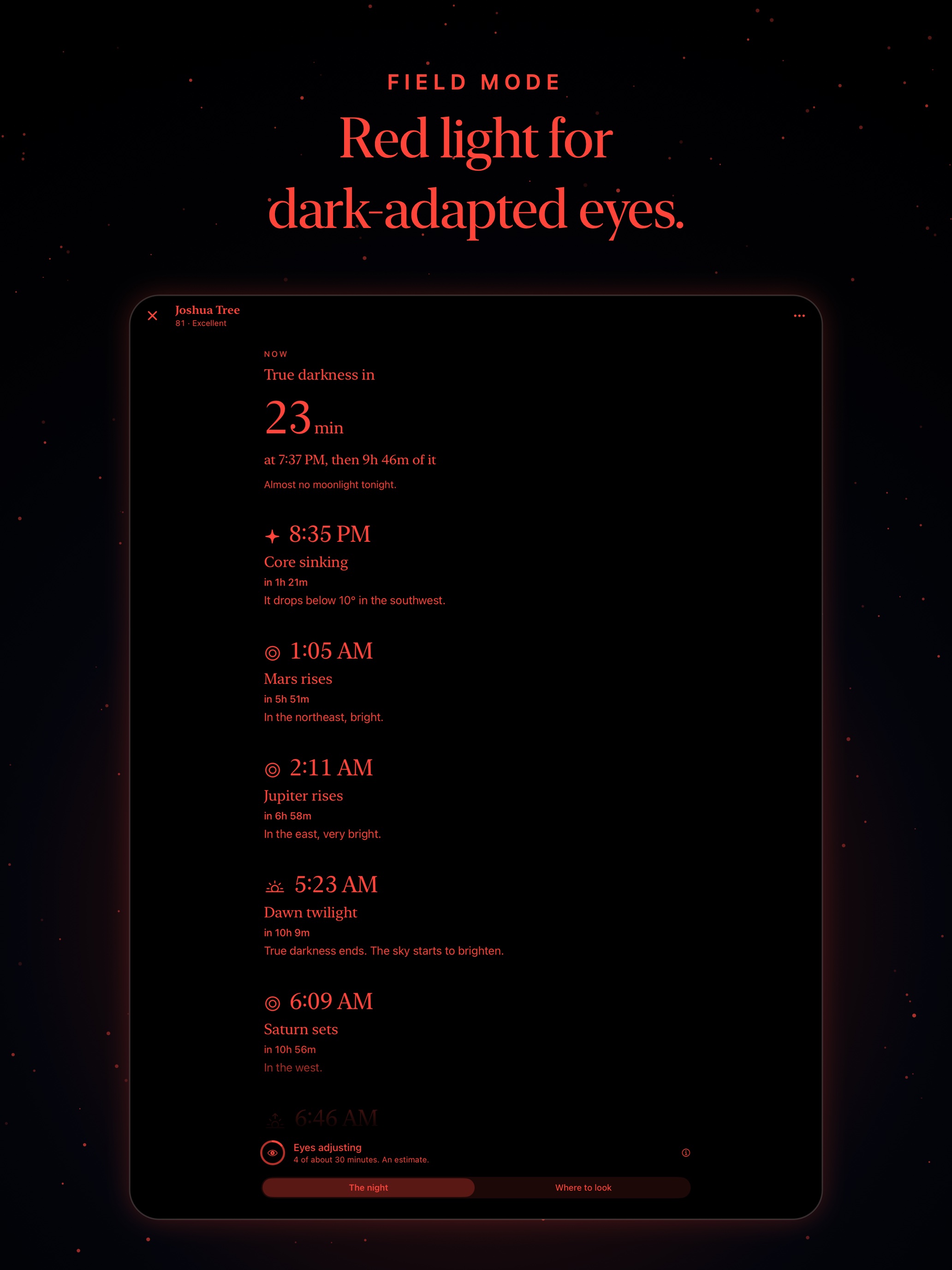
- Field mode. At the park, a red, dimmed screen counts down to true darkness, tracks how long your eyes have adapted, and turns the real sky to wherever you point the phone, with no camera. A Live Activity, alarms and a Control Center control come with it.
- Apple Watch. Tonight's score with the Digital Crown to look ahead, the forecast models' range when they differ, a thirty-minute dark-adaptation clock that taps your wrist, and complications that turn red at dusk.
- Apple Vision Pro. Stand under a US national park's computed sky on a chosen night, with star names and constellation figures, turn the night by hand, and place the Moon, with NASA's color map and relief, lit at its true phase, on your table.
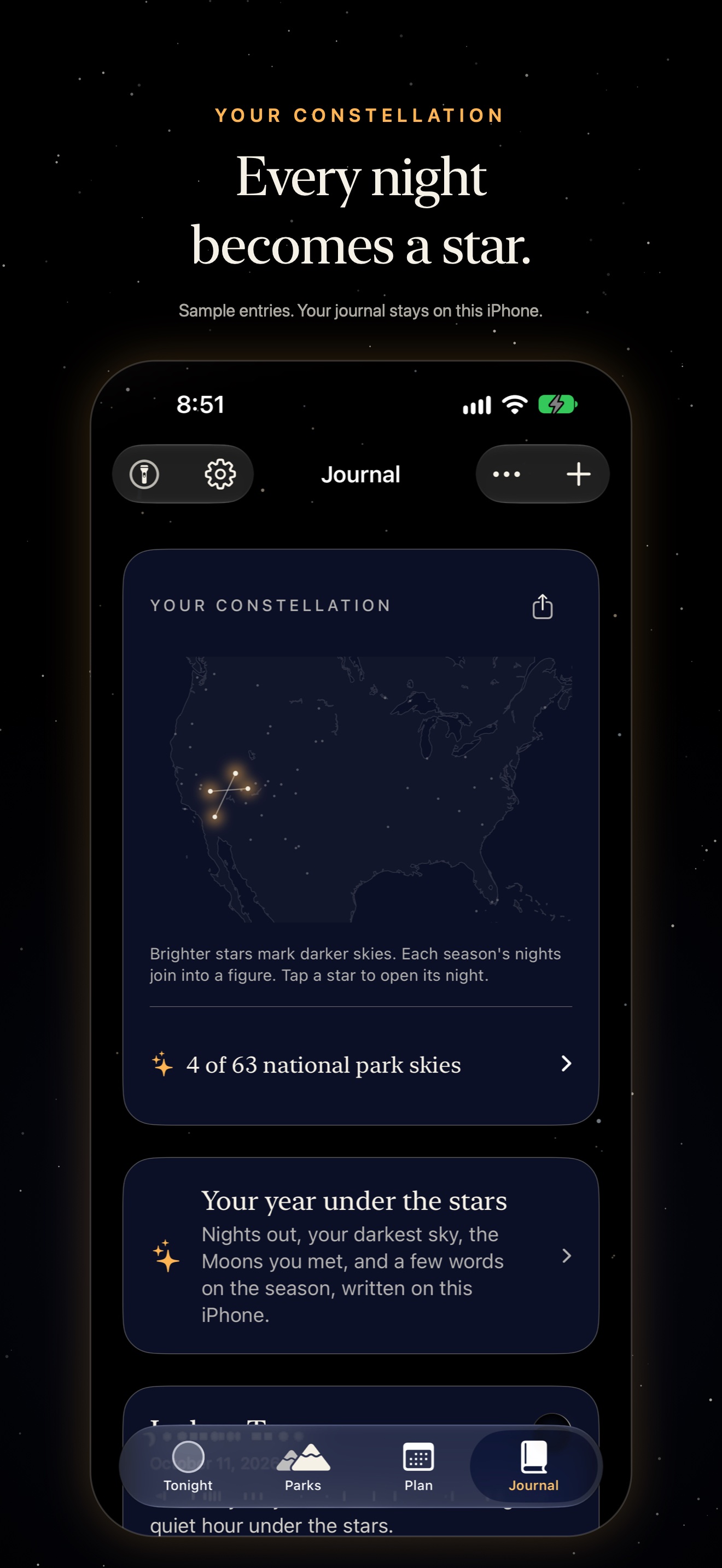
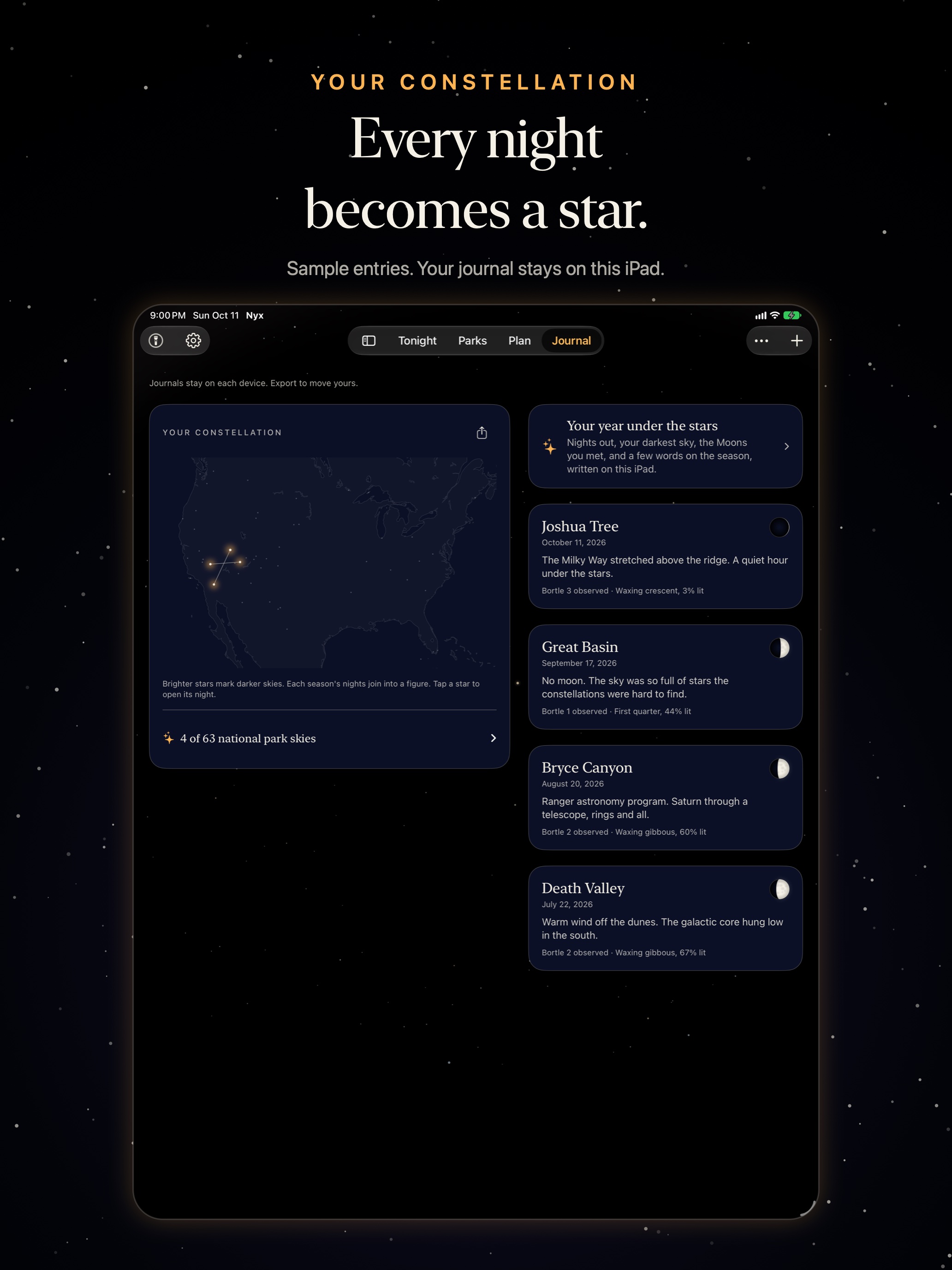
- A private journal with notes and selected photos; each night becomes a star in your own constellation. Add a night by voice with Siri. It can be exported as a file you keep.
- Around the system. Tonight and Moon widgets, Control Center controls for night vision and field mode, a Live Activity that follows a night and its forecast, Siri and Shortcuts, Spotlight, and Handoff between your devices.
Accessibility
- VoiceOver: every custom control, including the dial, the Moon, the time river, the sky arc and the calendar nights, speaks a summary of its data. Audio graphs let you hear a month of darkness.
- Sound and touch: "Listen to tonight" plays the shape of the night as tones with a transcript; haptics can follow the Moon's phase. "Feel tonight" plays the night as touch; touch and hold the shape of the night to read any hour, and on iPhone feel it hum under your finger. In field mode a tone placed around you leads you toward the core.
- Text and display: VoiceOver, Dynamic Type up to the largest accessibility sizes, Reduce Motion, Reduce Transparency, Increase Contrast, Bold Text and Smart Invert are supported. Assistive Access shows one answer in large type.
- Night-adapted eyes: night vision for the whole app, with measured contrast (red text on black 6.2:1).
- Getting there: step-free notes for viewing spots, each quoting the park's own accessibility page.
- Evidence, stated plainly: Apple's automated accessibility audit passes on 32 screens of the iPhone app in both palettes in the simulator, and on ten key screens at the largest text size; a few findings it cannot sample were checked by eye. The Watch and Vision Pro apps are not covered by it. Testing on physical devices, and with people who use assistive technologies, is the next step and not yet complete.
Boilerplate
50 words
Nyx is a free app that shows where and when the sky will be darkest: at the 63 US national parks and about 3,400 dark-sky places worldwide. It turns the Moon, the clouds, the sky glow and the hours of true darkness into one score, works offline and collects no data.
100 words
Nyx is a free dark-sky planner for iPhone, iPad, Apple Watch and Apple Vision Pro. It covers the 63 US national parks, about 3,400 national parks and certified dark-sky places in 172 countries, and any spot you save. For each place and night it gives a darkness score from 0 to 100, built from the Moon, the clouds, the sky glow and the hours of true darkness, and explains it in four plain parts. At the US parks, closures sit beside the number. The astronomy runs on the device, and Nyx has no account, advertising or tracking.
200 words
Nyx is a free dark-sky planner for the darkest nights, wherever you are, with the 63 US national parks at its heart. It answers one question: where should I go, and on which night? For each place and night, Nyx gives a darkness score from 0 to 100: at the 63 US national parks, checked by hand, at about 3,400 national parks and certified dark-sky places in 172 countries, and at any spot you save. The Moon, the clouds, the sky glow and the hours of true darkness each add points, and the weakest can cap the total, so an overcast night never looks good. At the US parks, closures sit beside the score. Nyx is honest about uncertainty. Nights beyond the forecast use each place's usual clouds and say so, sky glow is called an estimate, and abroad Nyx says it cannot check closures. At the park, field mode turns the screen red and counts down to true darkness. Nyx also runs on Apple Watch and Apple Vision Pro. The astronomy runs on the device. There is no account, advertising or tracking, and Nyx speaks five languages. One independent developer made it.
Images
App Store frames from Nyx 2.0, captured on October 11, 2026 with live forecasts and park alerts, scored by the app's own engine. Select an image for the full-size file. The journal frames and the saved spot use sample data.
App icon
Nyx app icon, 1024 × 1024 PNG. Please show it unaltered, on a dark background.
iPhone (1320 × 2868, shown smaller)
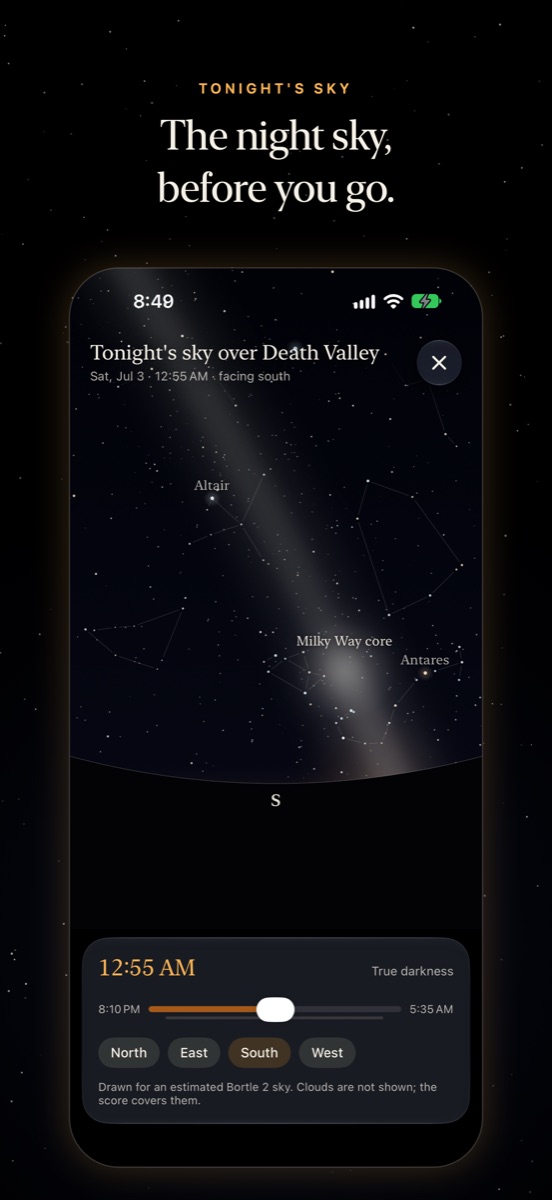
Tonight's sky 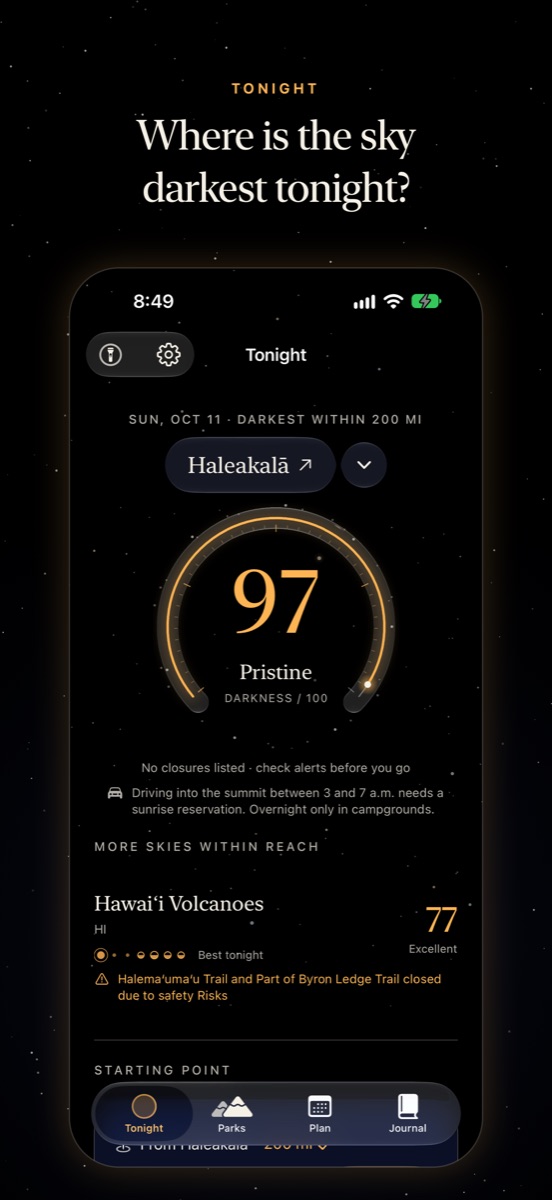
Tonight 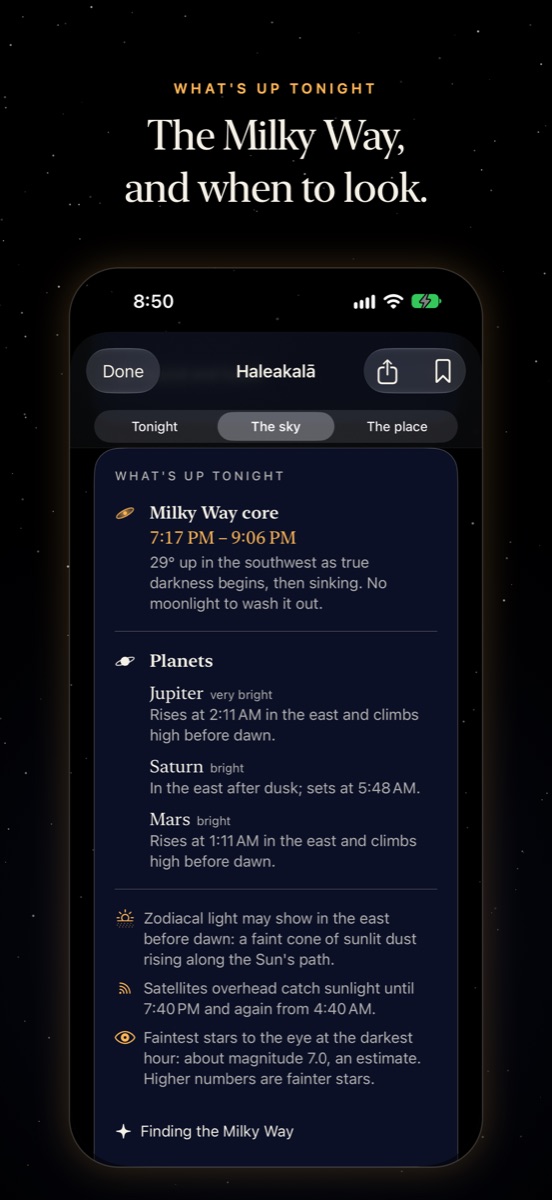
What's up tonight 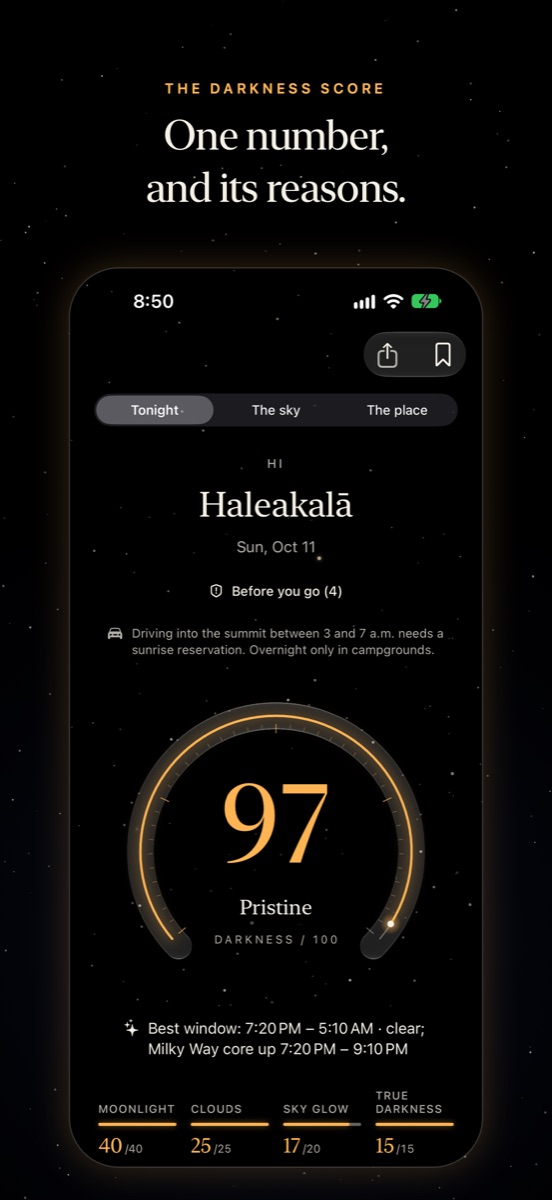
The score and its reasons 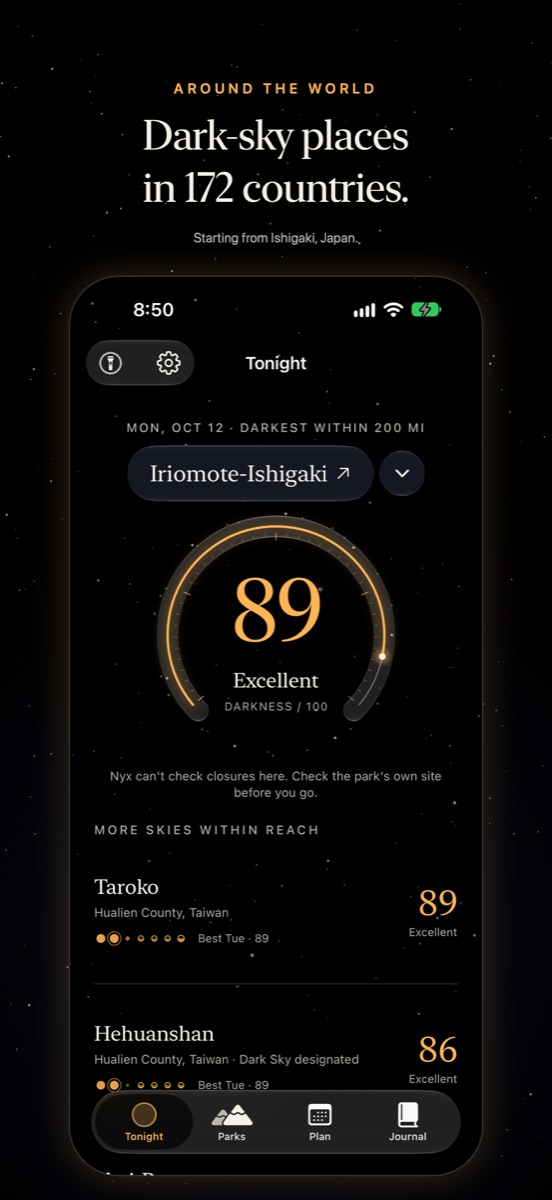
Around the world 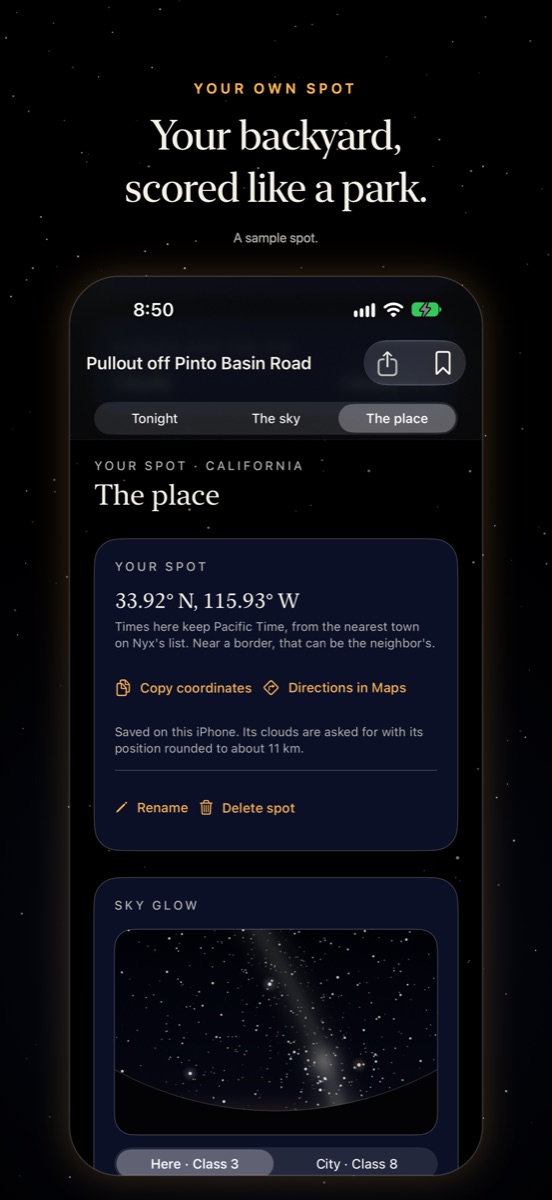
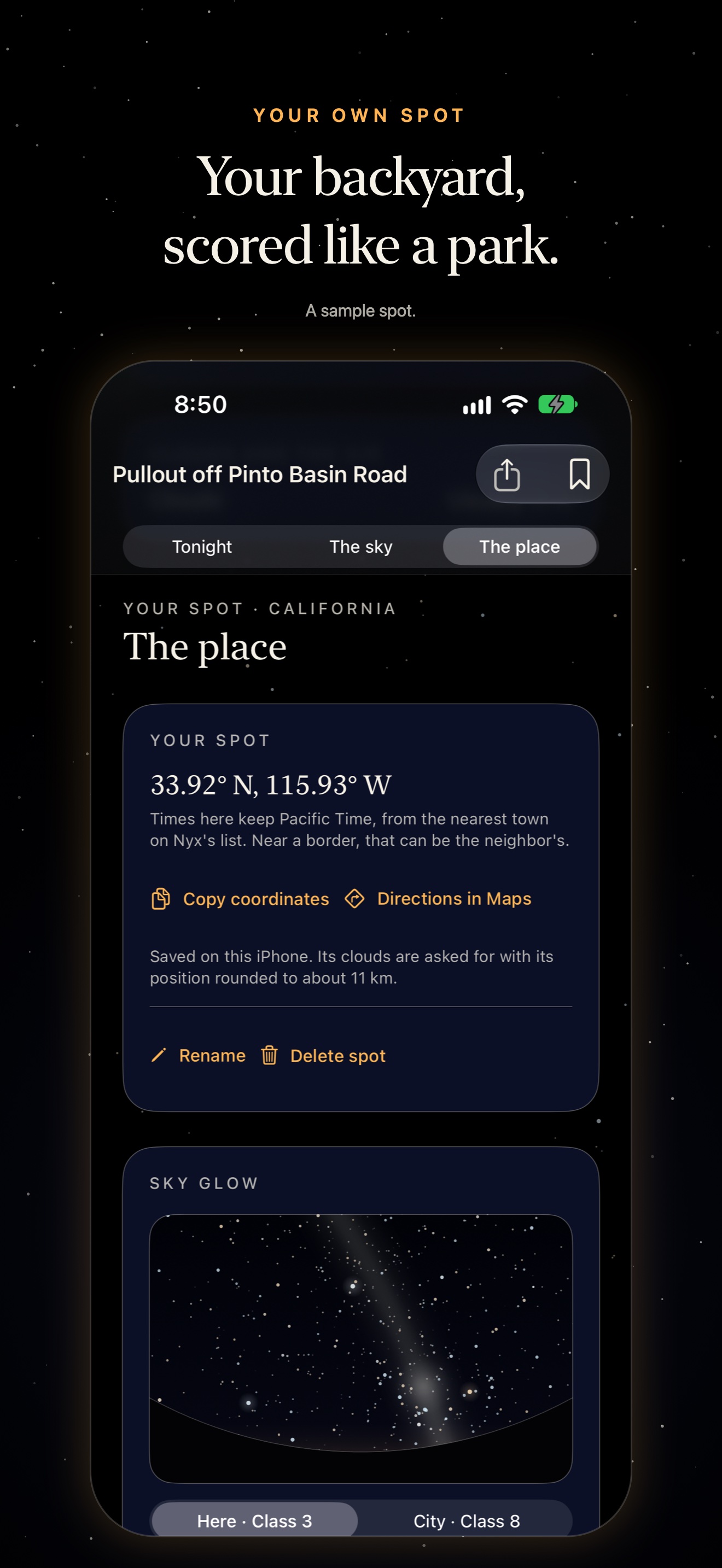
Your own spot (sample) 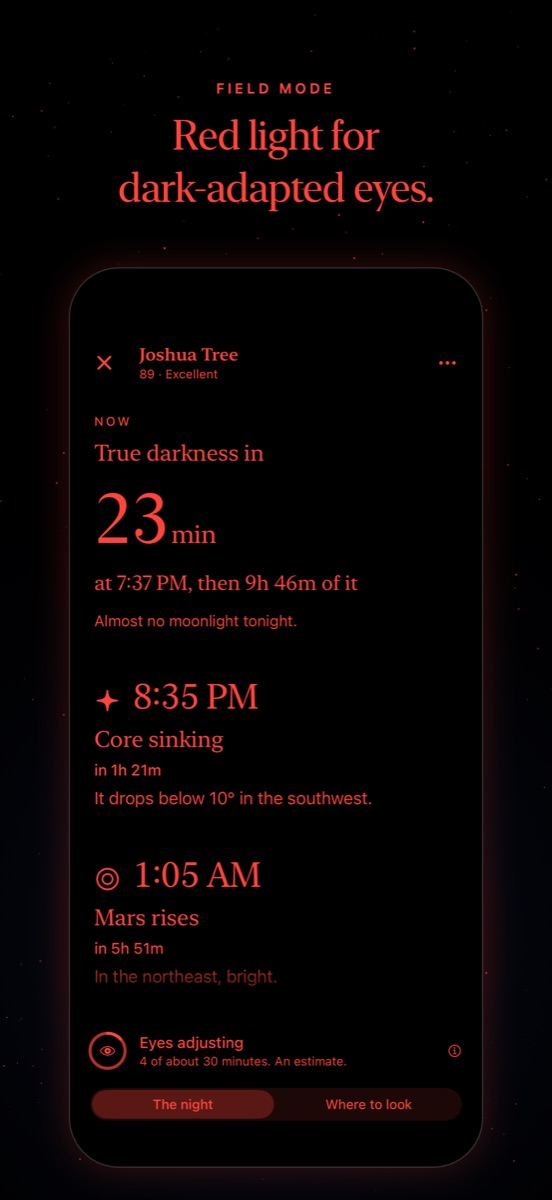
Field mode 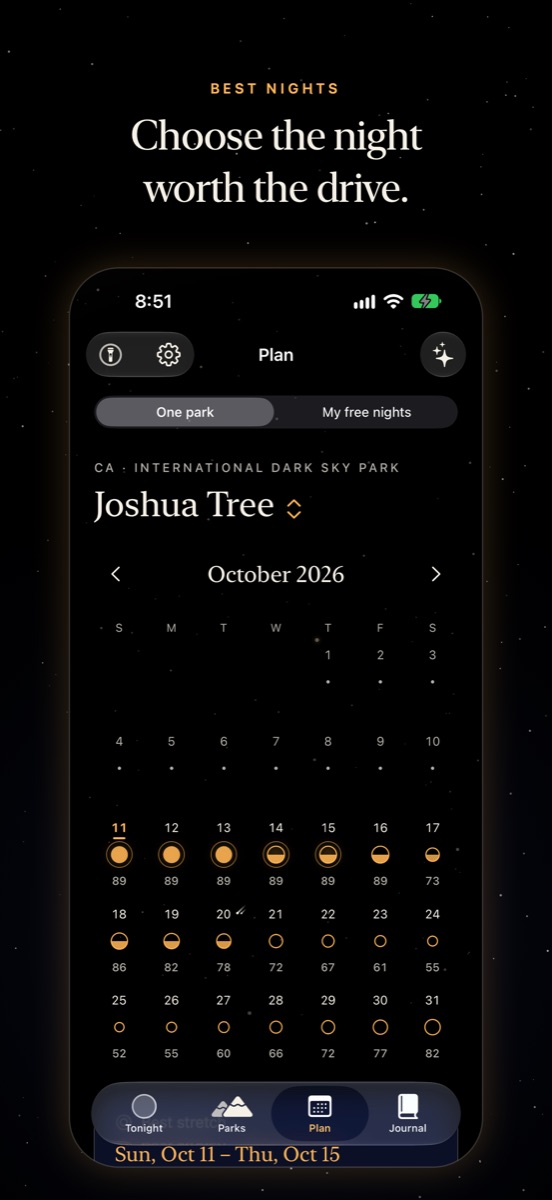
Best nights 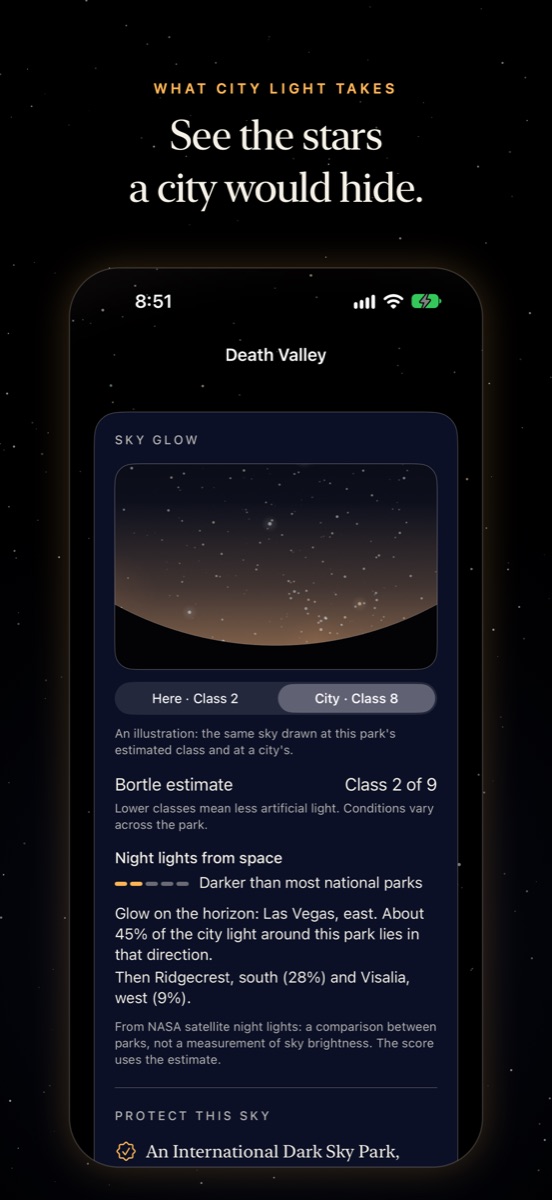
What city light takes 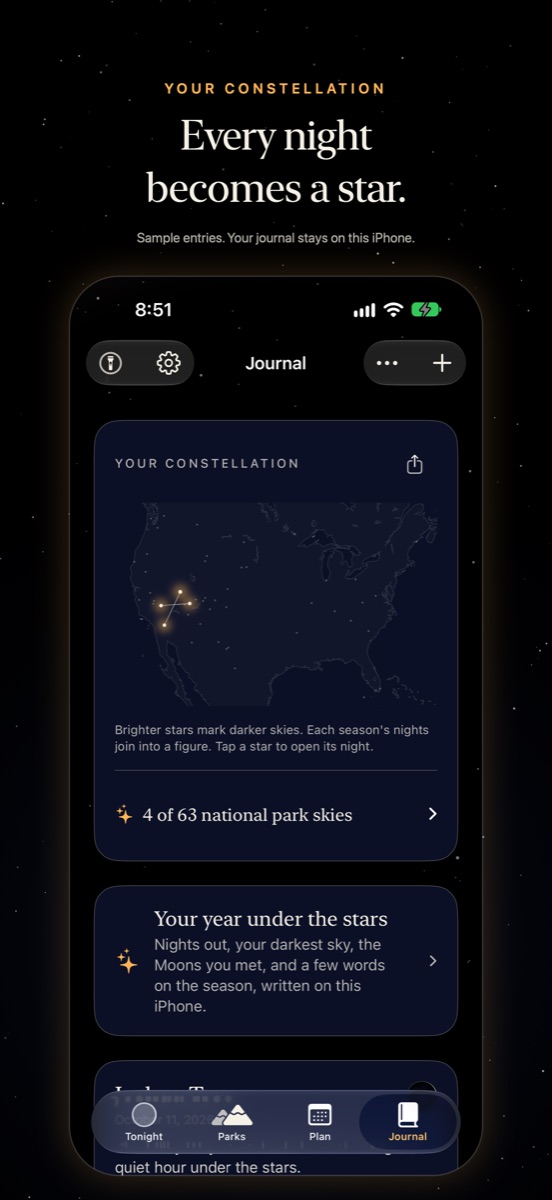
Your constellation (sample entries)
iPad (2064 × 2752, shown smaller)
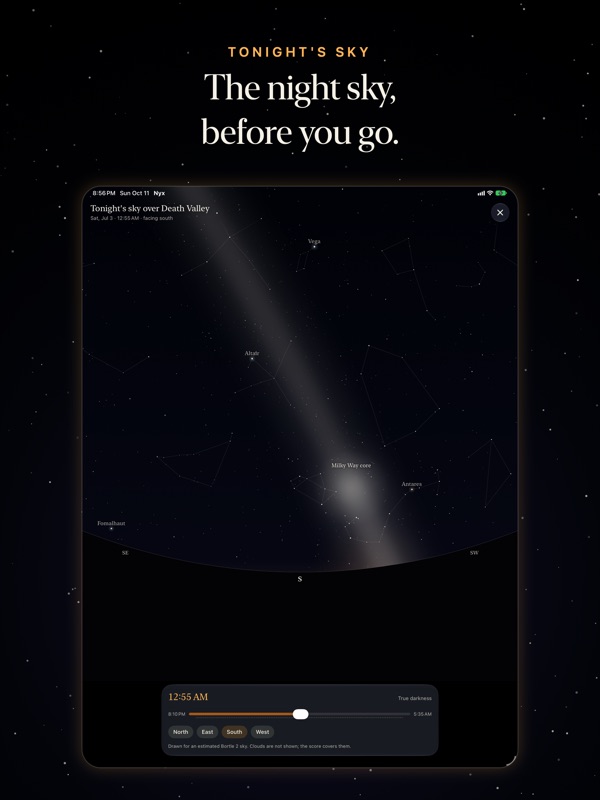
Tonight's sky 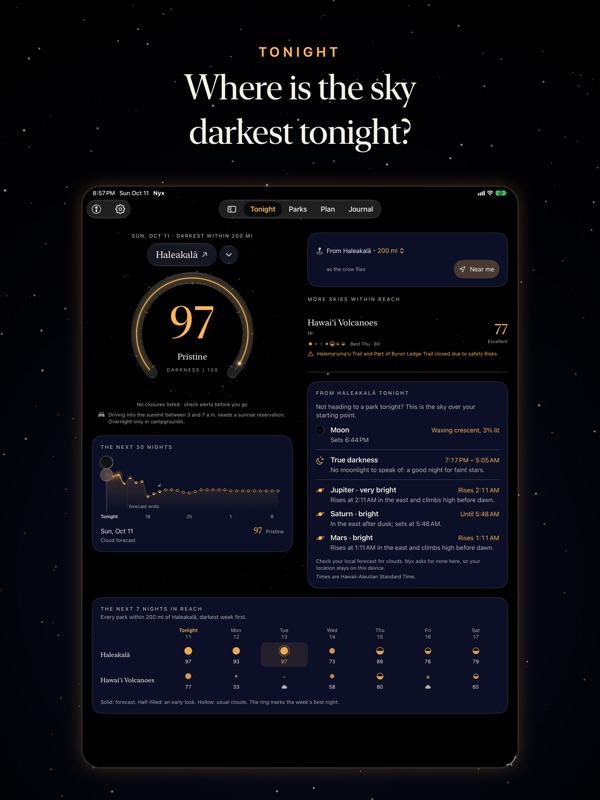
Tonight 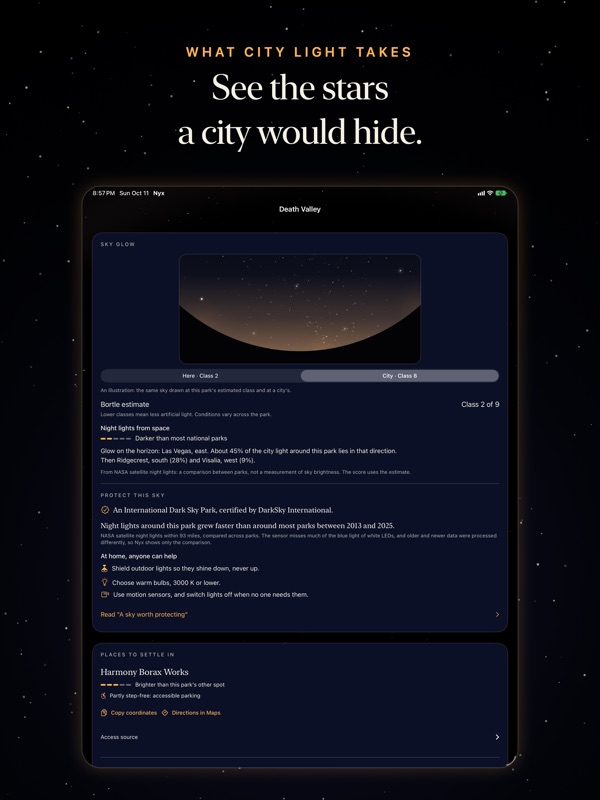
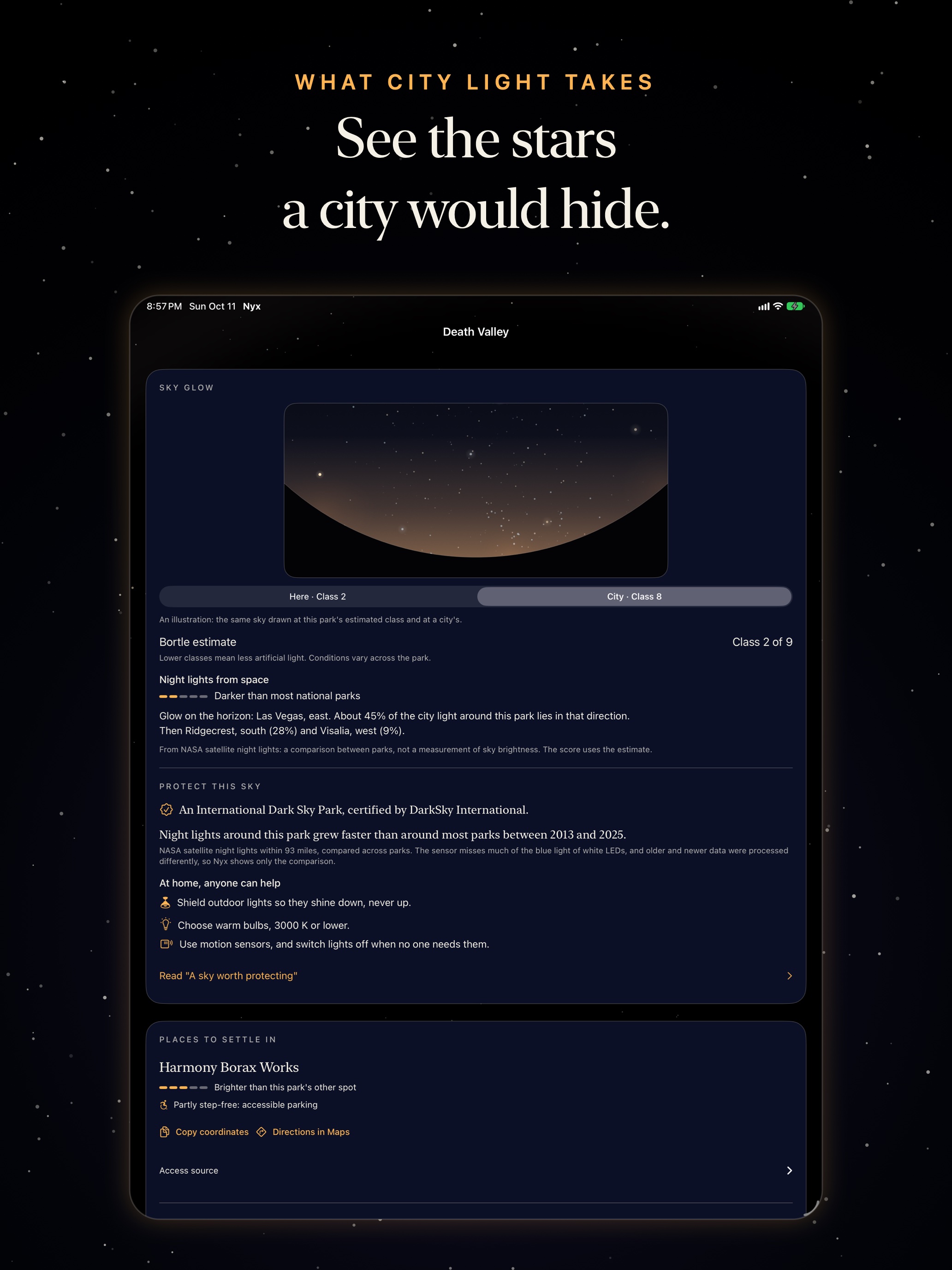
What city light takes 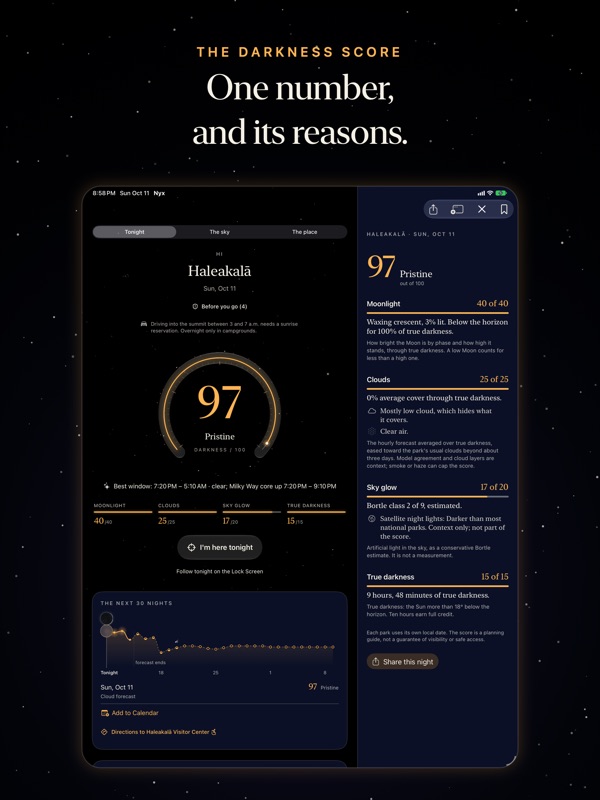
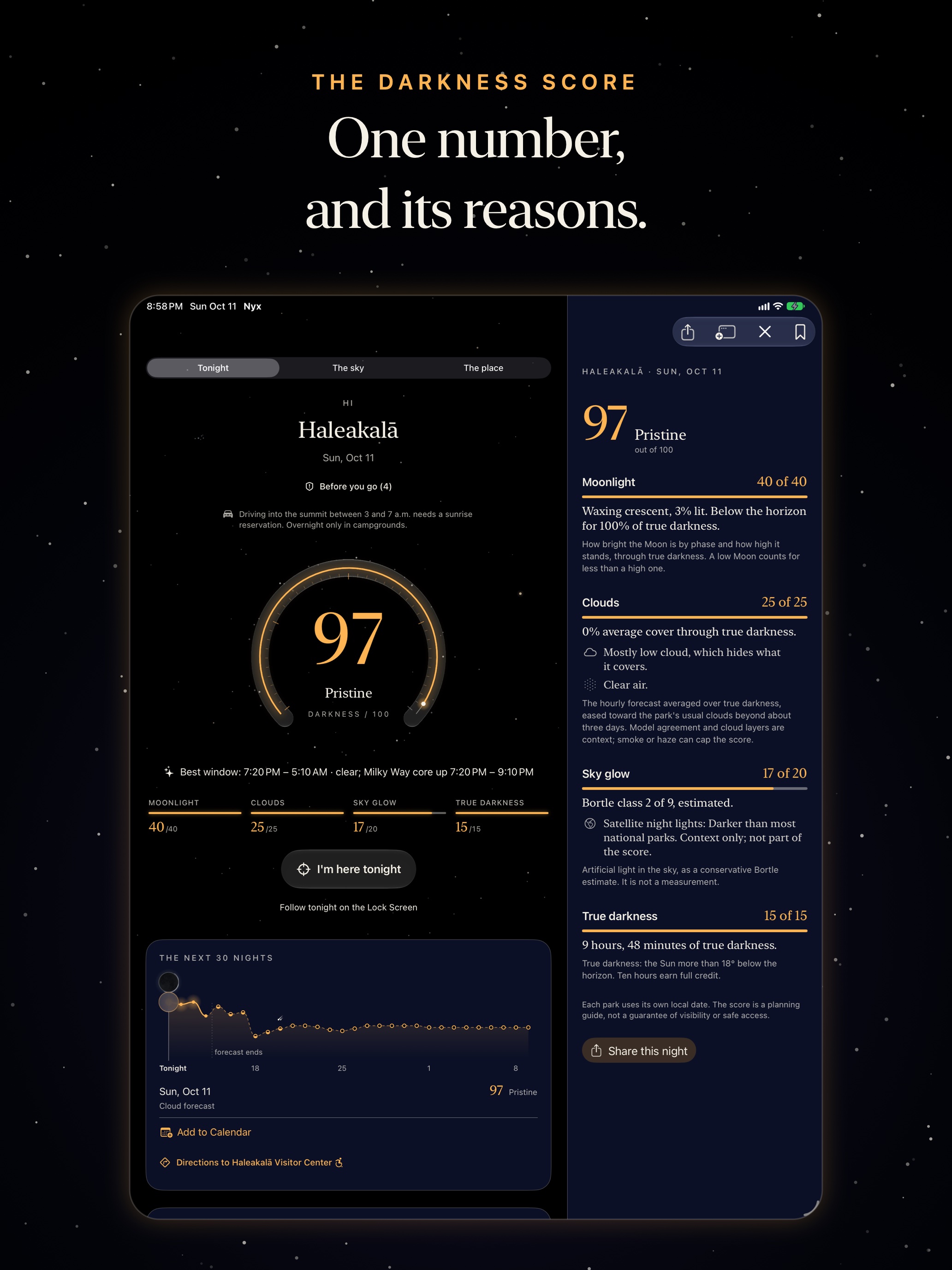
The score 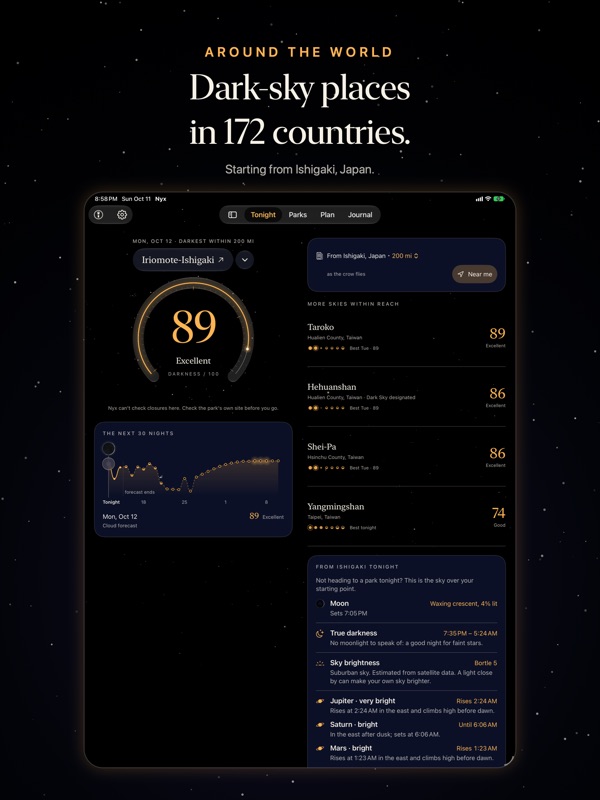
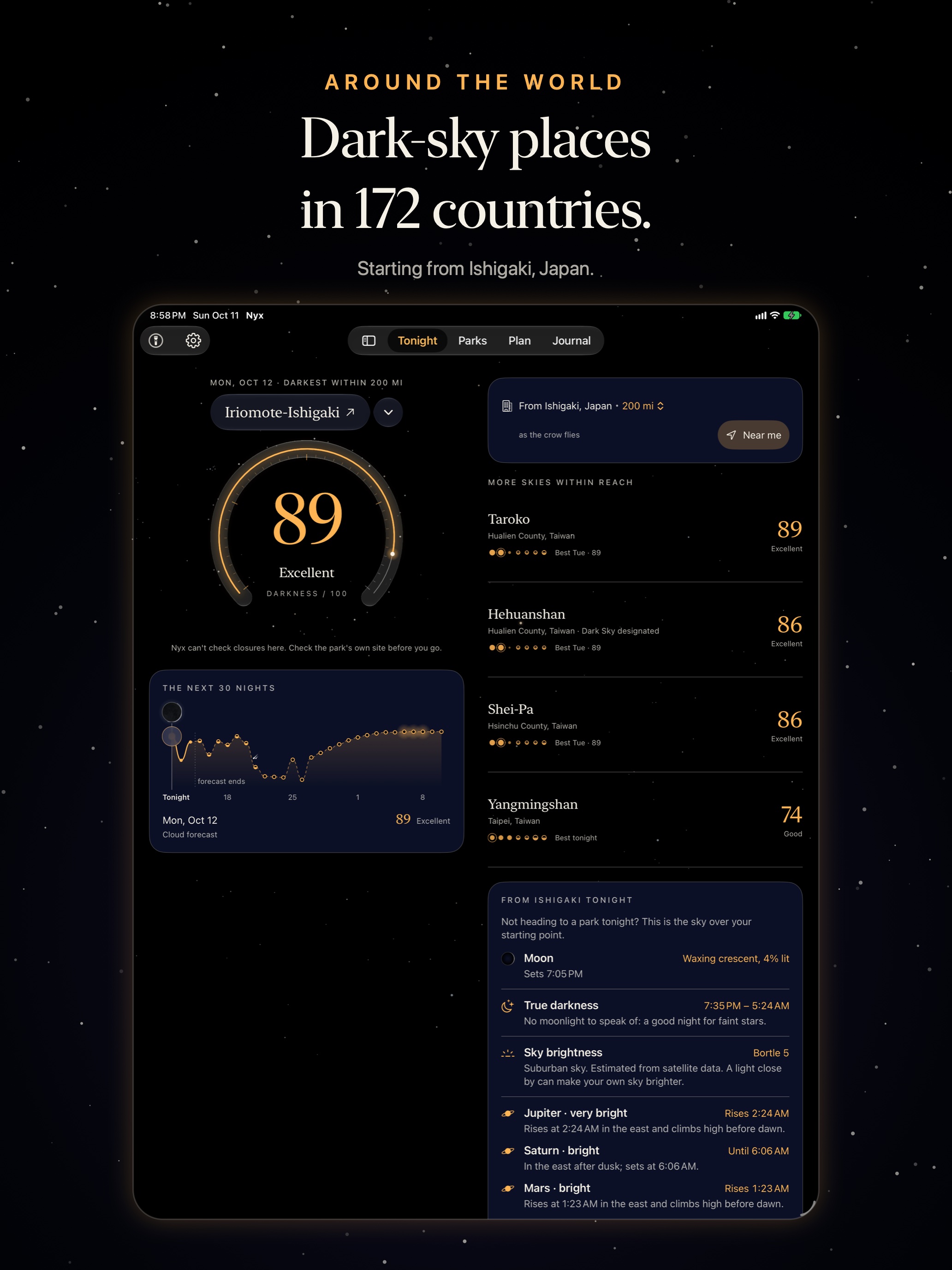
Around the world 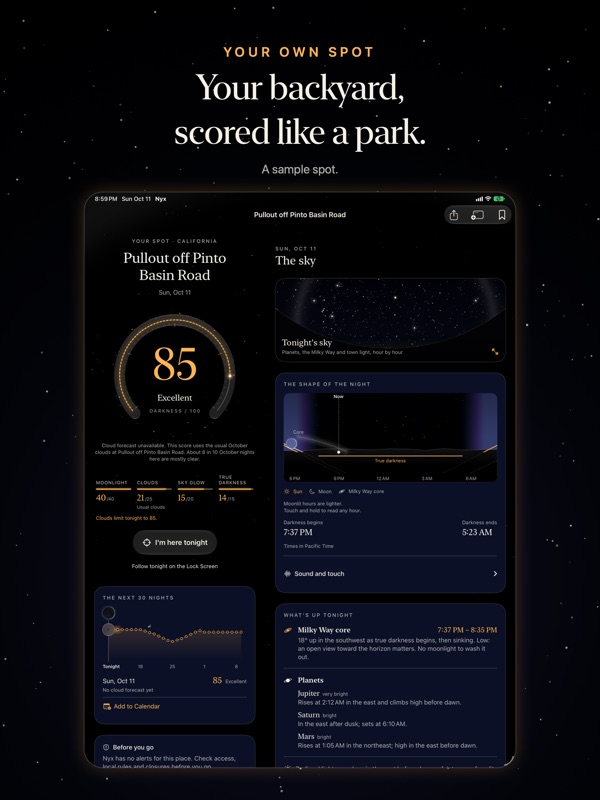
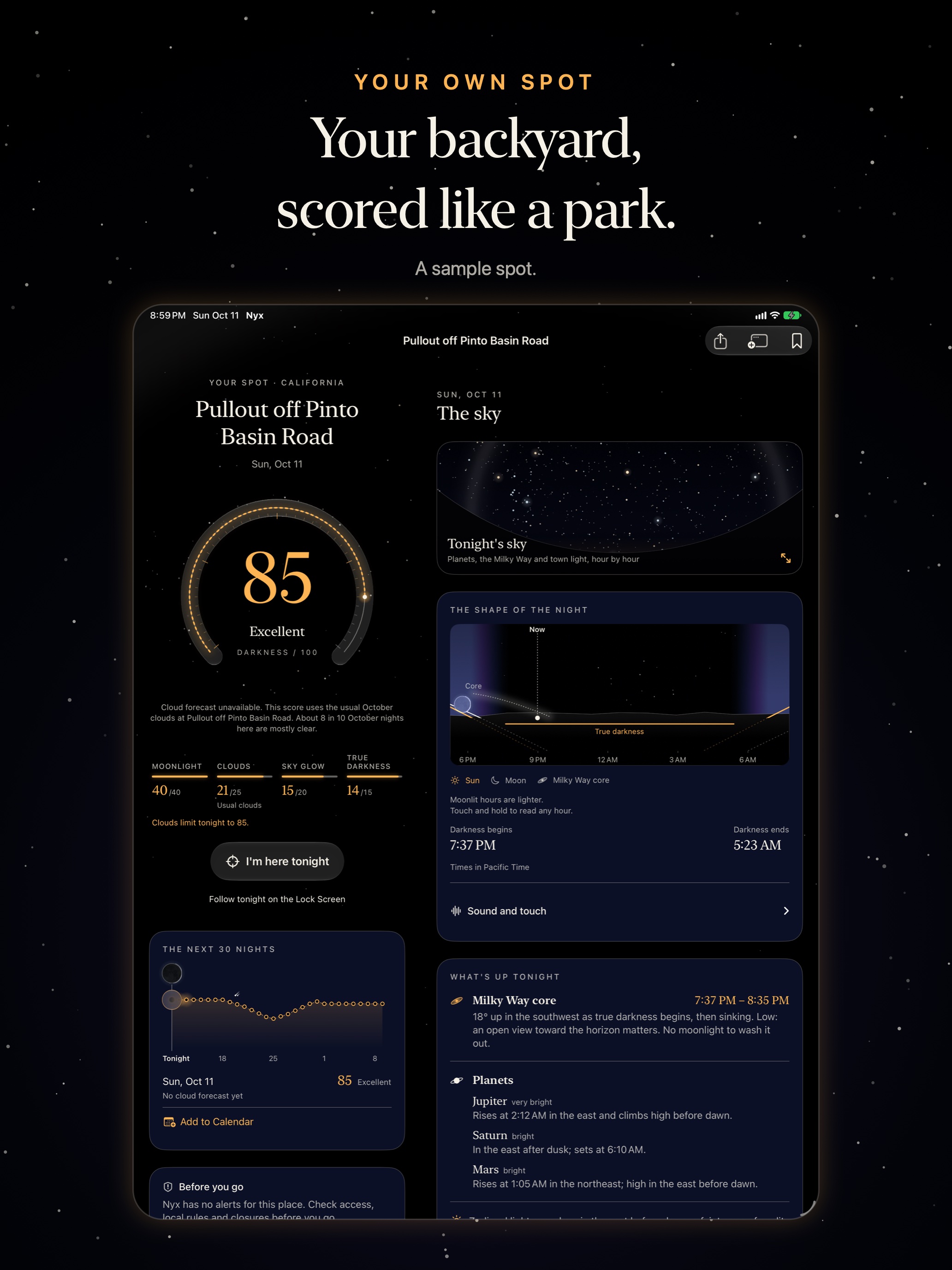
Your own spot (sample) 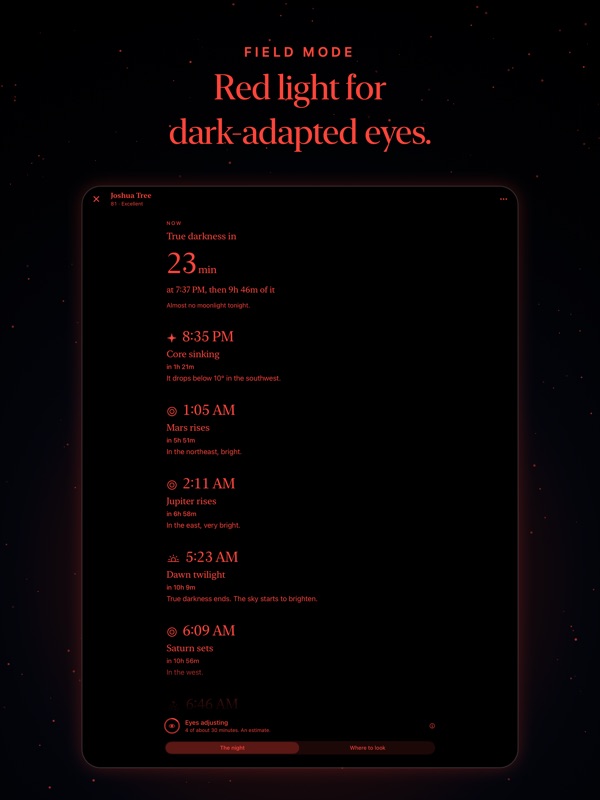
Field mode 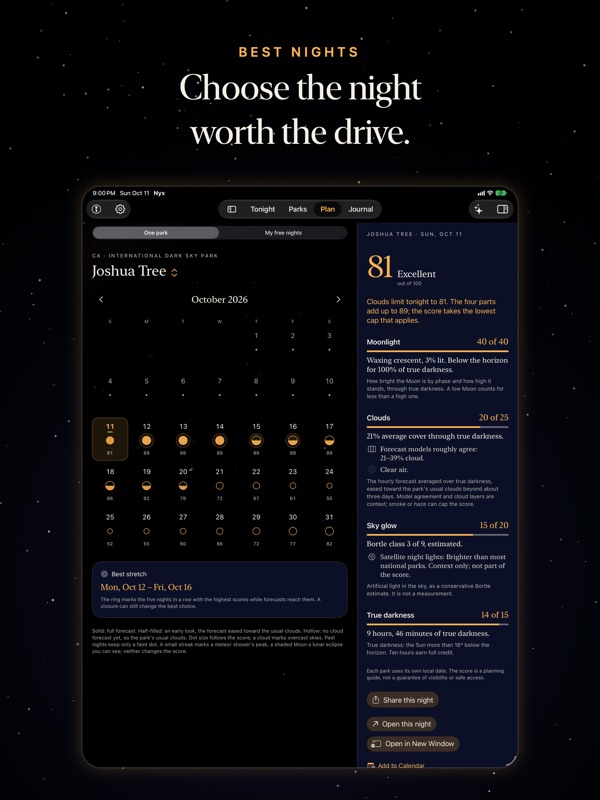
Best nights 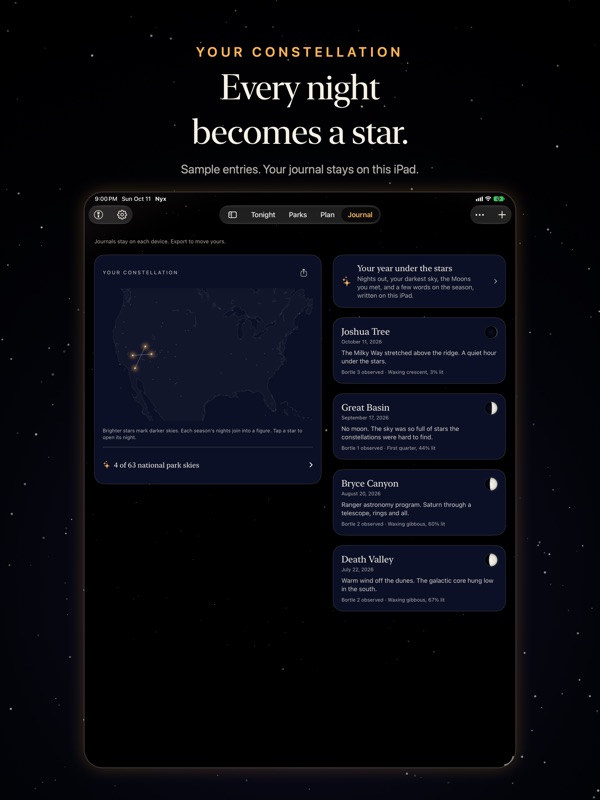
Your constellation (sample entries)
Apple Watch (422 × 514)
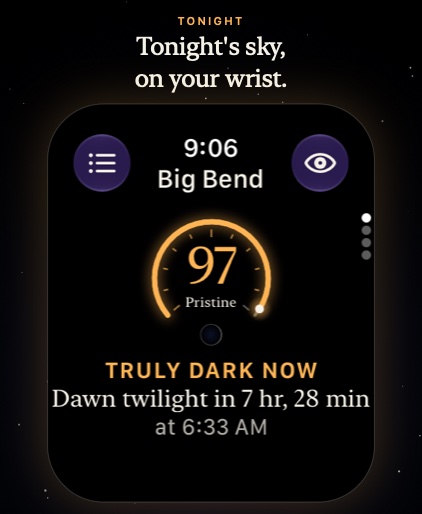
Tonight 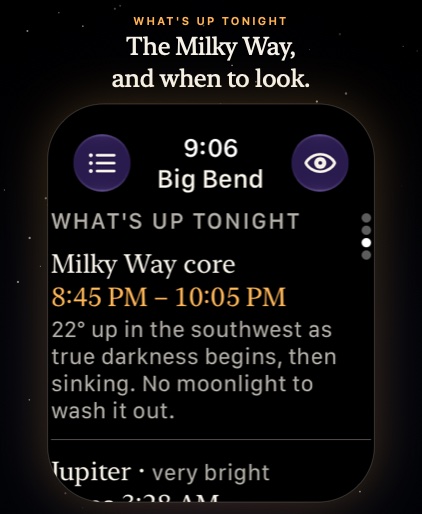
What's up tonight 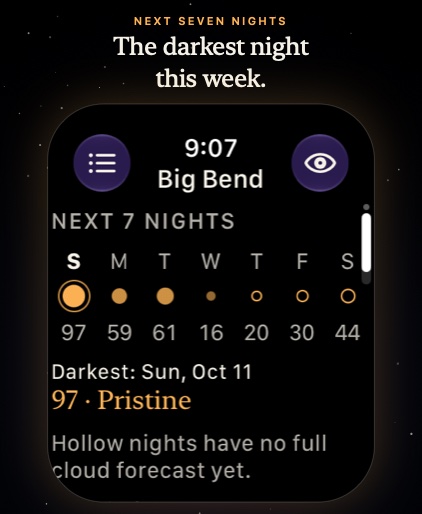
Next seven nights 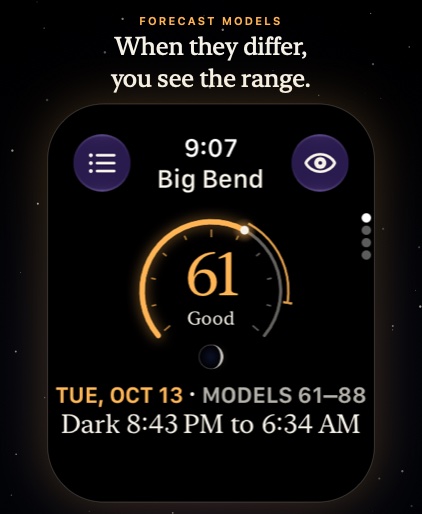
Forecast models 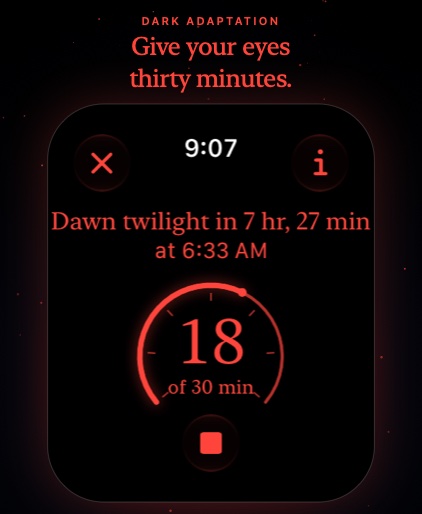
Dark adaptation 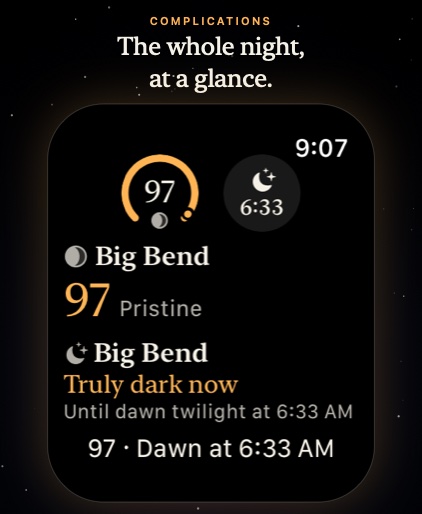
Complications 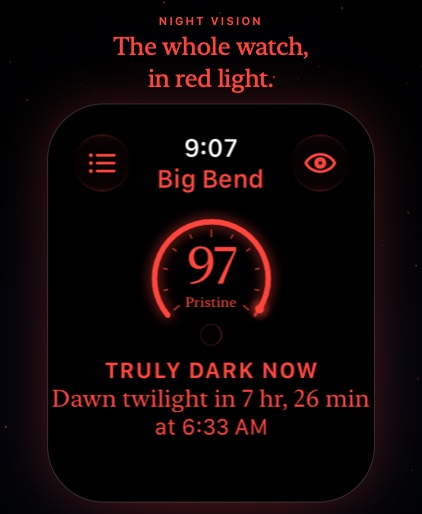
Night vision
Apple Vision Pro (3840 × 2160, shown at 1920)
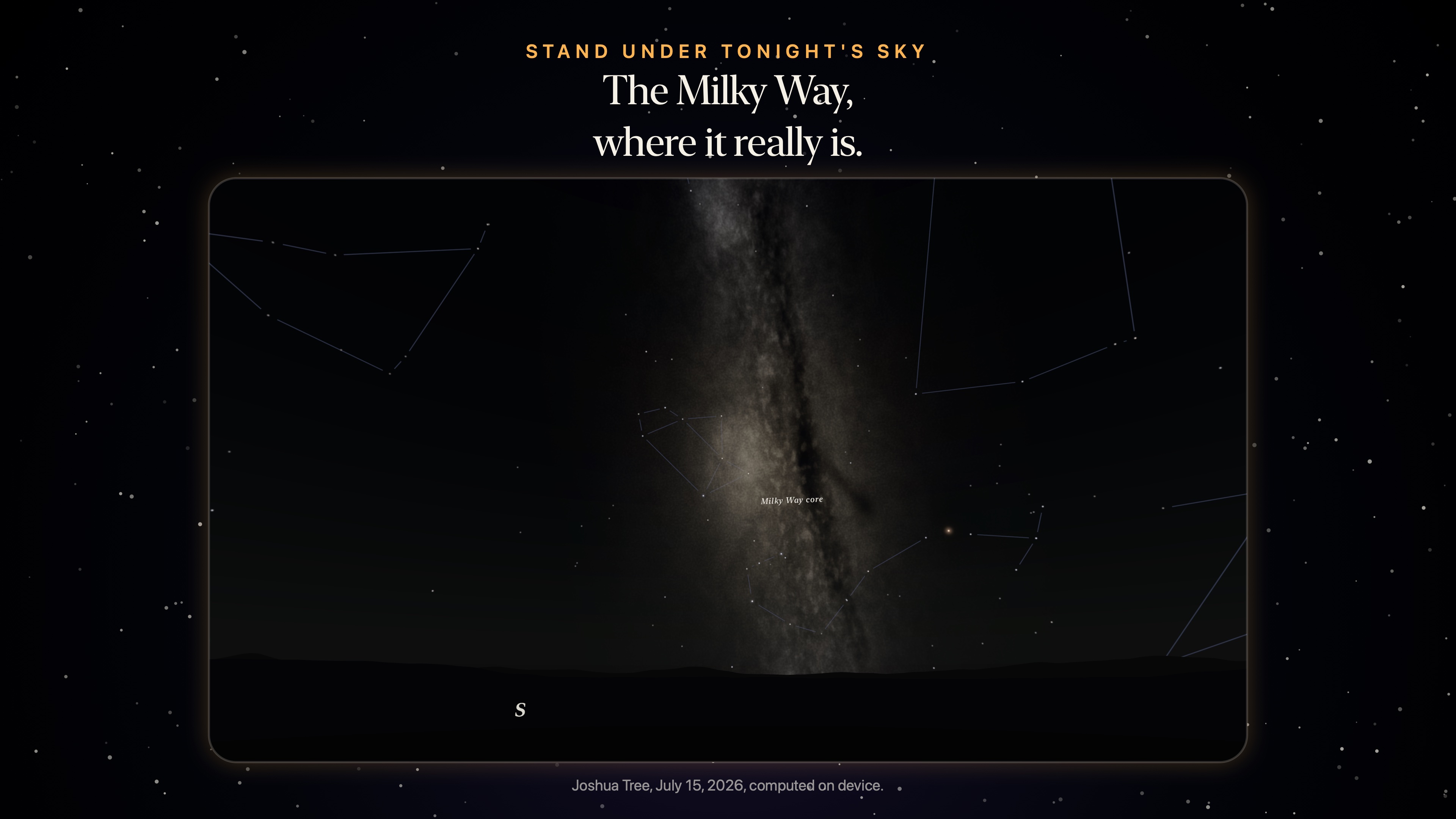
Under the sky 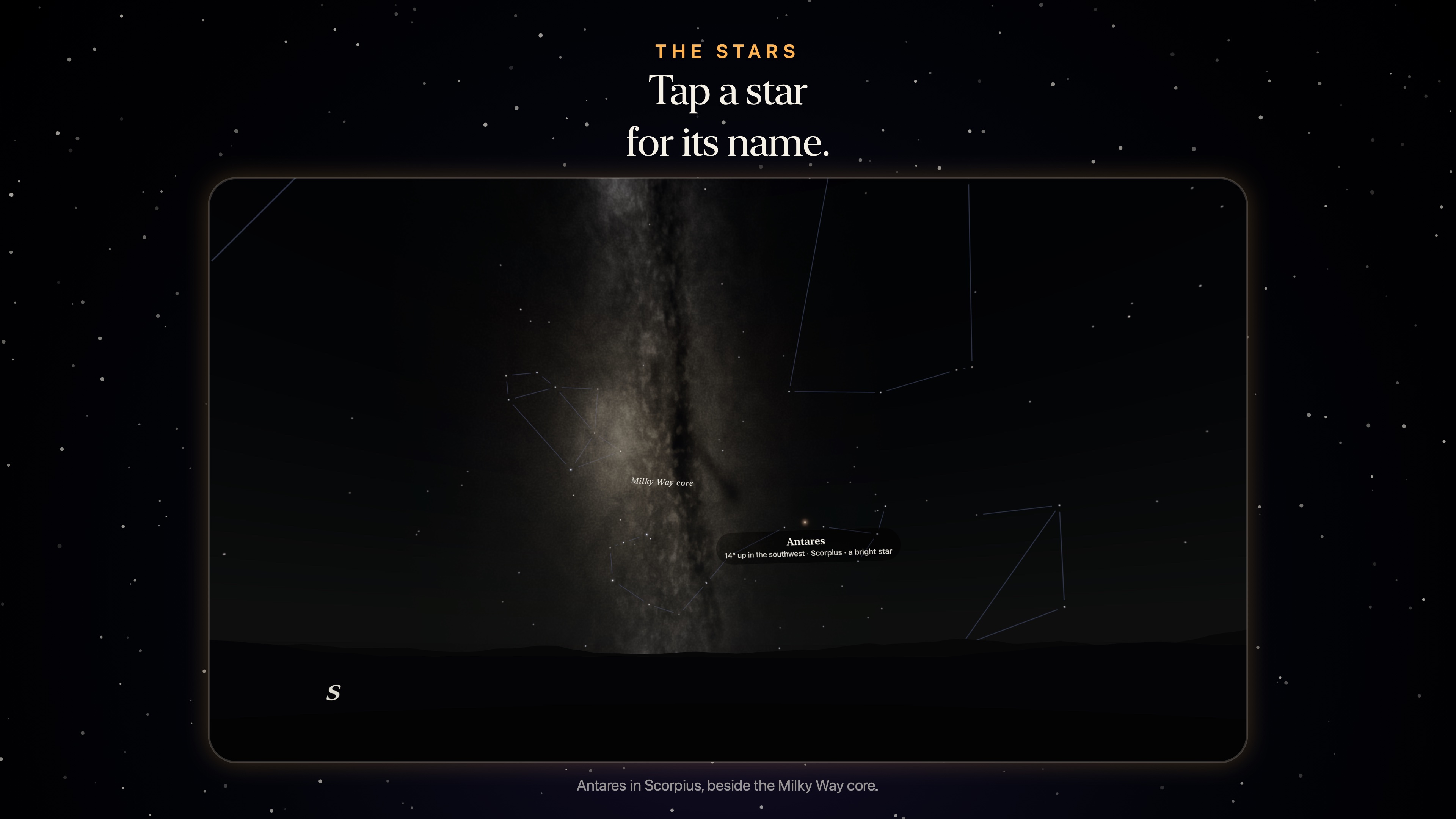
Names in the sky 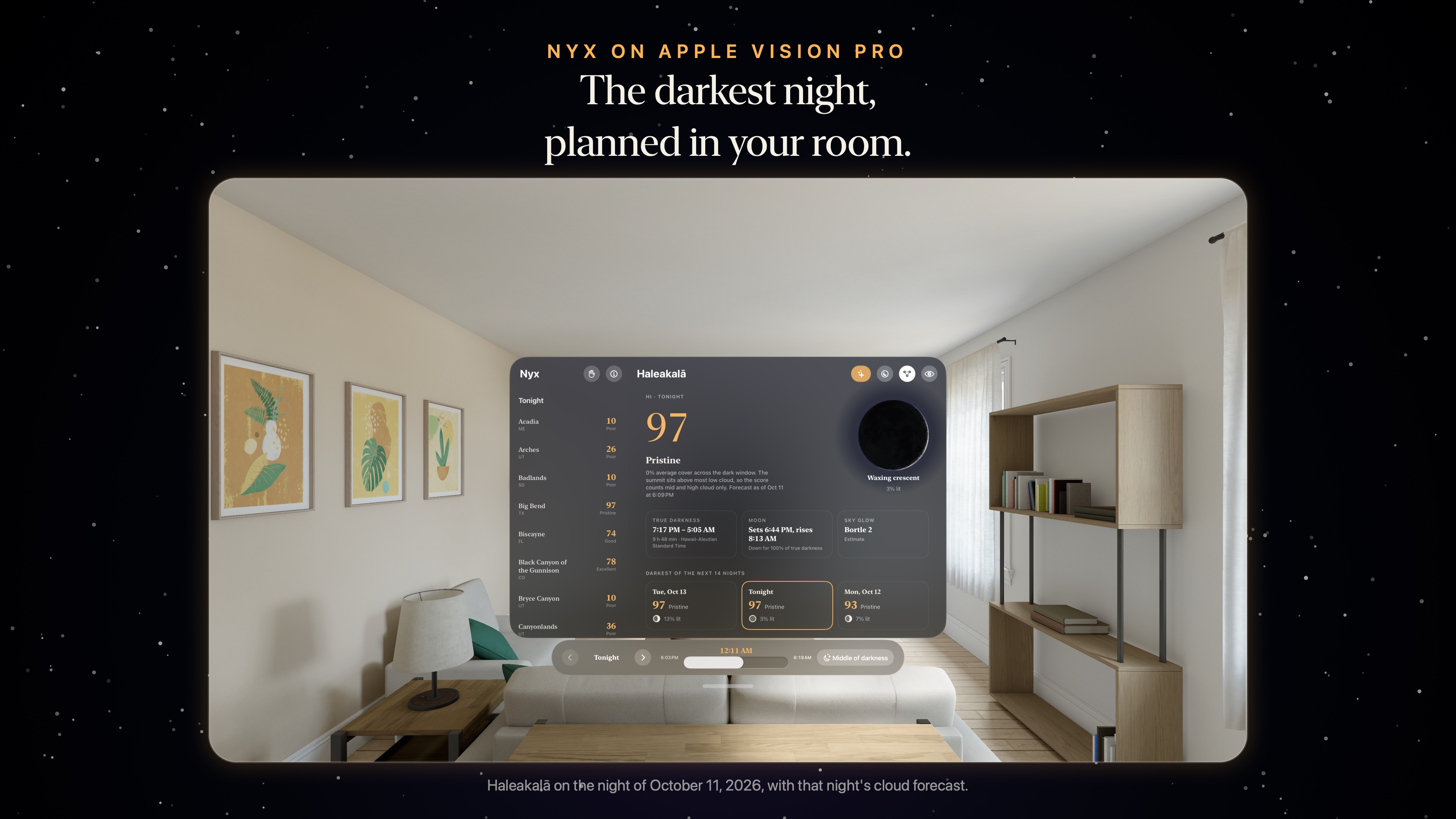
The planner 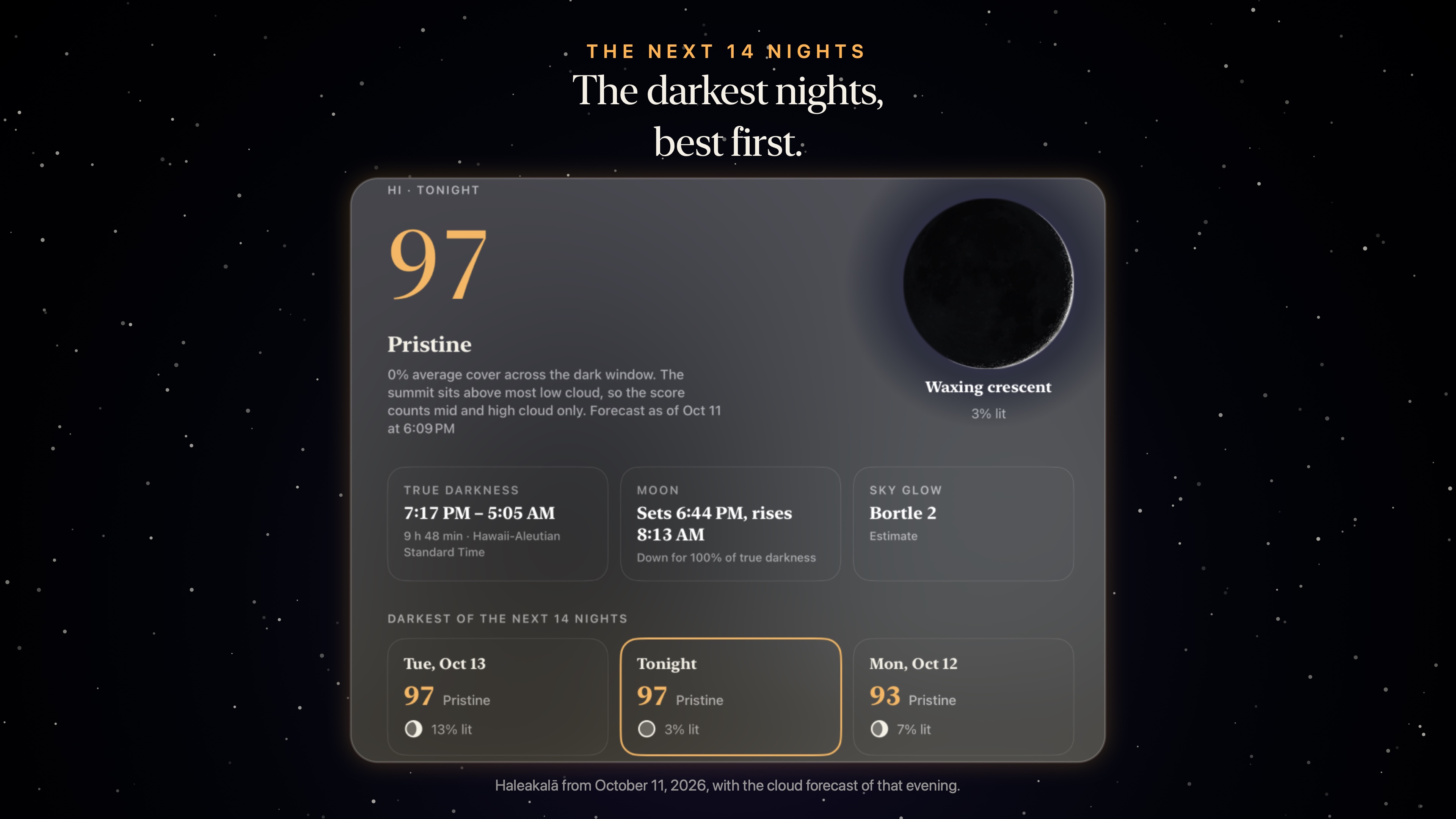
The next 14 nights 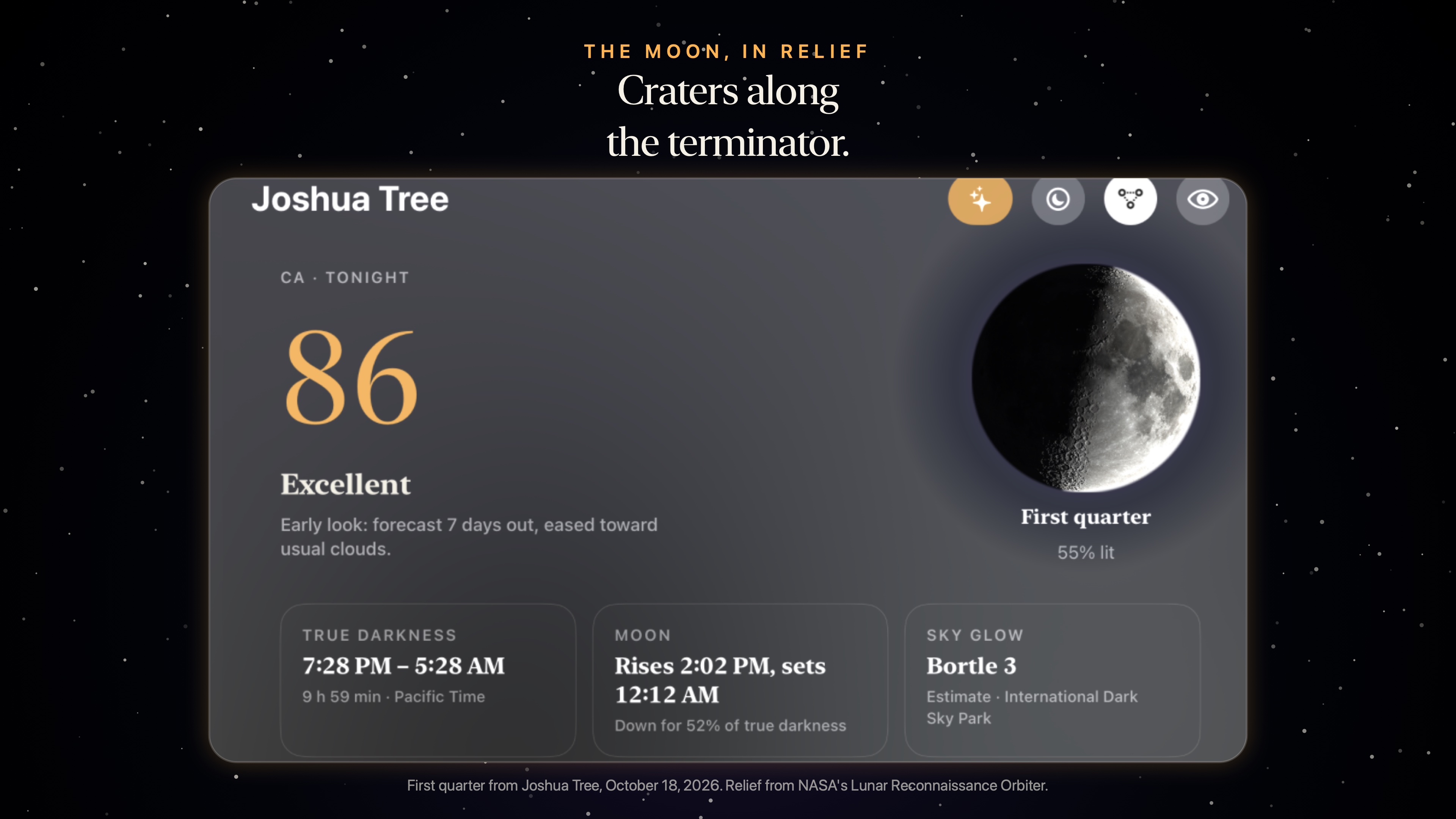
The Moon in relief 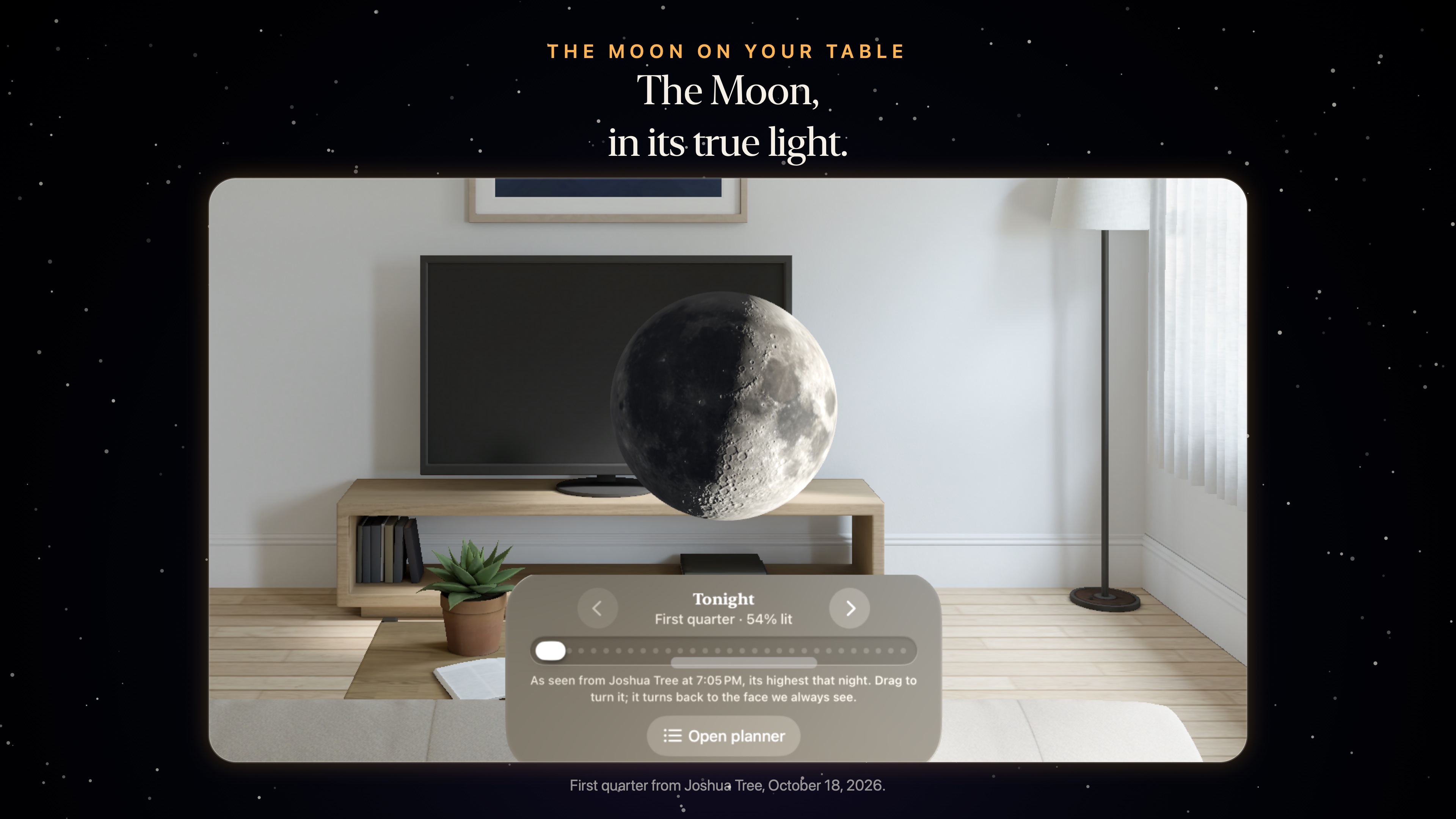
The Moon on your table 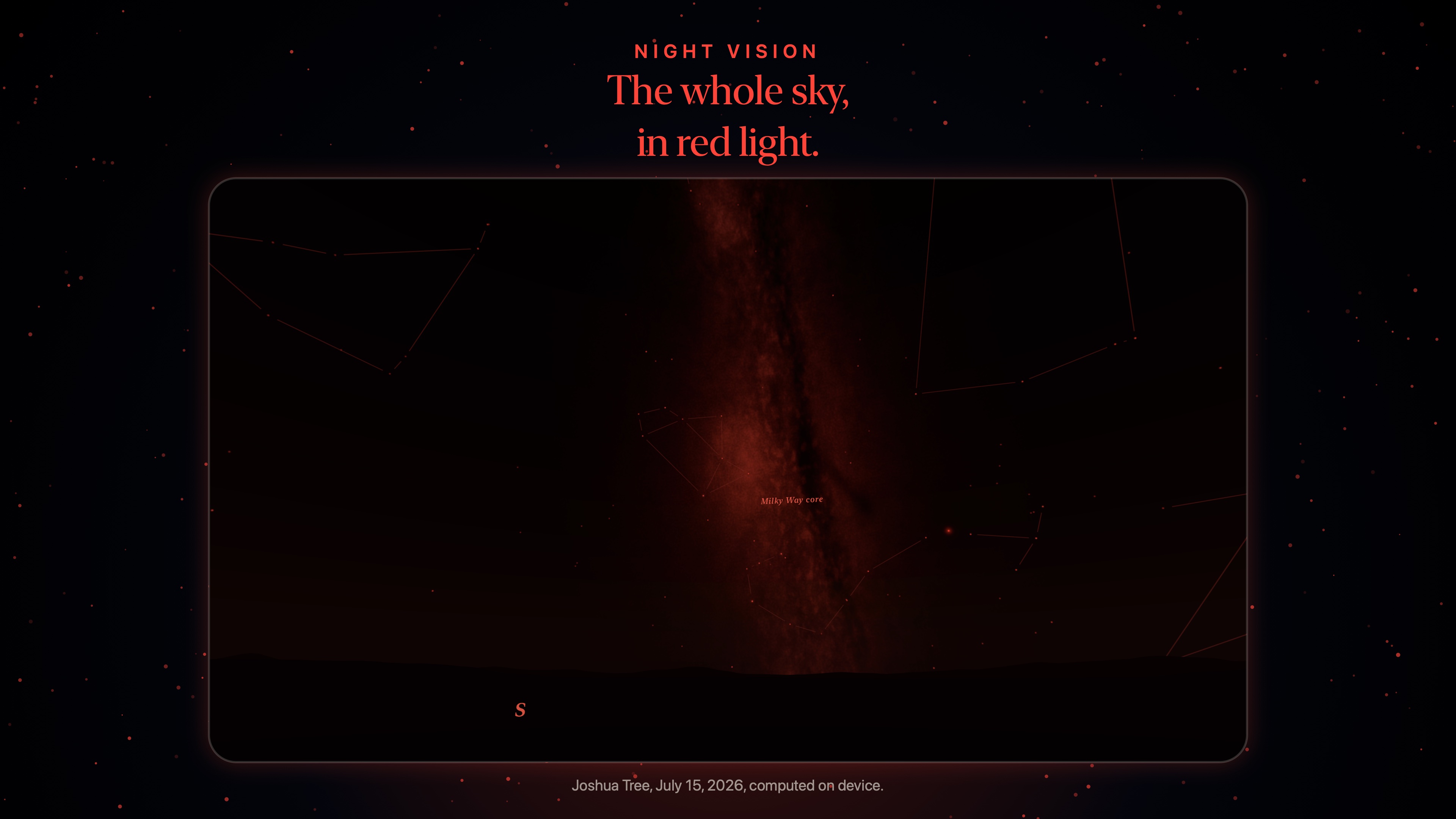
Night vision
The Moon in these images is drawn from NASA data and the stars from the Yale Bright Star Catalogue. Please do not add National Park Service, NASA or DarkSky International marks to Nyx artwork. A 30-second screen recording and review access through TestFlight are available on request.
The numbers, and where they come from
- 63 US national parks, 85 named viewing spots, 18 International Dark Sky Parks among them (as of July 2026).
- 3,359 national parks and certified dark-sky places in 172 countries from Wikidata (141 of them dark-sky designated), and more than 31,500 towns and cities to start from.
- 0 data collected: no server, no analytics, no account. Three public services supply data, each with its own switch.
- Moon rise and set times agree with the U.S. Naval Observatory to within 3.7 minutes at mid-latitude parks and to within a minute at the parks checked in Alaska, Hawaiʻi, American Samoa and the Virgin Islands; sunrise, sunset and twilight to within a minute.
- 903 stars from the Yale Bright Star Catalogue behind every screen.
Data sources and credits
- Weather: Weather data by Open-Meteo.com, licensed CC BY 4.0; averaged over each night's true darkness by Nyx.
- Usual clouds: contains modified Copernicus Climate Change Service information (2026): ERA5, 2015 to 2024 (Hersbach and others, 2020; DOI 10.24381/cds.adbb2d47), CC BY 4.0. Neither the European Commission nor ECMWF is responsible for any use that may be made of the Copernicus information or data it contains.
- Smoke and haze: contains modified Copernicus Atmosphere Monitoring Service information (2026), via Open-Meteo. Neither the European Commission nor ECMWF is responsible for any use that may be made of the Copernicus information or data it contains.
- Sky glow: NASA Black Marble nighttime lights (VNP46A4, DOI 10.5067/VIIRS/VNP46A4.002), public domain; method after Román and others (2018).
- The Moon: NASA's Scientific Visualization Studio (CGI Moon Kit); LRO LROC and LOLA teams.
- Stars: the Yale Bright Star Catalogue, via NASA HEASARC. Star names on Apple Vision Pro: IAU Working Group on Star Names.
- Meteor showers: International Meteor Organization, 2026 Meteor Shower Calendar.
- Lunar eclipses: Eclipse Predictions by Fred Espenak, NASA's GSFC.
- Planets: Paul Schlyter's low-precision orbital elements, computed on the device.
- Parks, alerts and ranger programs: the National Park Service.
- Places around the world: Wikidata, CC0. Starting towns: GeoNames, CC BY 4.0, and the U.S. Census Bureau, public domain. World map: Natural Earth, public domain. Aurora notes: IGRF-14 geomagnetic field model, NOAA NCEI.
Nyx is not affiliated with or endorsed by the National Park Service, NASA or DarkSky International, and no organization named here endorses Nyx.
Sources for this page
- National Park Service, news release, March 13, 2026: "The National Park Service today announced it recorded more than 323 million recreation visits in 2025." nps.gov. Back
- Manning, R. and colleagues, night-sky visitor research at Acadia National Park, Park Science, September 2015, as reported by the University of Vermont. uvm.edu. Back
Contact
Hardik Pakhale · harry.pakhale98@gmail.com. Interviews, TestFlight access and further images on request.